Showing posts with label Catechism. Show all posts

1/25/22

Hurling Stones at Our Goliath

Where a lone man may be overcome, two together can resist. A three-ply cord is not easily broken. 

~Ecclesiastes 4:12

You might need somethin' to hold on to
When all the answers they don't amount to much
Somebody that you can just talk to
And a little of that human touch.

~Bruce Springsteen

🍃

One evening around fifteen years ago, I stopped into a co-op with a friend of mine. We were either coming from somewhere, or heading somewhere, I do not recall, but somehow it made sense for us to stop there for dinner. I don't remember the name of the place, but it was kind of like a local version of Wholefoods. Smaller, more personal.

“The expensive grocery store,” is essentially how I regarded it. The place I would stop in on occasion for a chocolate bar or something as I headed to the more affordable Trader Joe's just down the street.

He and I had met a few years earlier at Blessed Sacrament, a Dominican Parish in North Seattle, and together, over the next few years, exhausted nearly every Catholic opportunity in town. We attended a weekly rosary group out of St. Joseph's Parish on Capitol Hill, went to retreats at the Carmelite Institute of Spirituality in Stanwood, attended the novena to Our Lady of Mt. Carmel at the Discalced Carmelite Monastery in Shoreline, and sometimes on Sundays even hit up the Tridentine Mass at the Josephinum in downtown Seattle. We were bonafide Catholic junkies.

I didn't have a car, so he always drove. Sometimes, when he was dropping me off, he'd give me a gallon of triple filtered water he'd picked up at the co-op near his basement apartment in Greenwood. It tasted so pure and clean that I developed a habit of triple-filtering my water ever since. He was a gardener, and in the spring he'd drive me over to see his place, where he'd cultivated beds of beautiful, multi-colored dahlias.

He loved all sorts of chaplets. The rosary was central, and the Divine Mercy Chaplet as well, but also more obscure ones like the Chaplet to St. Joseph, with 15 sections of four beads, used to meditate on the virtues of this oft-overlooked saint. And he regularly participated in Father Gobbi's Cenacles from the Marian Movement of Priests. But his spirituality wasn't confined to the scope of the Magisterium. 

“You're hard to read,” he'd explained to me once. “Because you're a libra.”

There was nothing memorable about that particular evening. It was pretty ordinary. The two of us sat in the dining area eating soup and bread, chatting about this and who knows what else, on the way to our next engagement. It only stands out due to a passing comment he made as we were getting ready to leave. 

“The Blessed Virgin is behind this movement of co-op grocery stores.”

“What?” I started, as I looked at the patrons milling past, women in Lululemon leggings heading back to their multi-million dollar Capitol Hill homes. “Behind this lair of the ultra-affluent?”

I imagined the BVM would get her pom-poms out for people praying rosaries outside of Planned Parenthood, or for those who passed out sandwiches to displaced men at the St. Martin de Poors shelter on the waterfront.

But supporting a co-op that drew throngs of smarter-than-Jesus, more-money-than-God Seattle liberals?

“Pshaw,” I muttered under my breath. “I find that hard to believe.”

🍃

But I have mulled on his comment over the years.

Currently, I live in a town where the main street is comprised of stores chock full of tchotchkes, artisan salts, puzzles and soy candles. The Rite Aid exclusively sells candy, hair products and alcohol. The owner of the nearest mall, twenty miles away, stopped paying on his loan about a year ago, and the mall just sold at a foreclosure auction to the bank who held the mortgage. The bank is uncertain what it plans to do with it.

Twenty years ago, this same main street had a drug store, an office supply store, a hardware store, and two auto part stores. The Rite Aid sold everything. The mall was the county's retail pit stop, were everyone shopped for shoes, clothing and electronics, and afterwards dined on pizza and Orange Julius' at a busy food court.

Now, the covid pandemic has really eviscerated the soul from this community. We conduct our everyday lives between the big big box stores and the internet. The monoliths have brought us to their logical conclusion: local retail has shut its doors and we all flock to Walmart or Amazon for their amHAZingly affordable offerings of pretty much anything. Workplaces have transitioned to remote or hybrid models, and nearly half of those born after 1980 say they'd quit their job if remote work isn't an option. Given the great resignation of 2021, this probably isn't just talk. Our social lives are conducted via video conference platforms, or highly addictive social media channels like Facebook, Twitter and Instagram. (I once taught a student who said she'd spend up to 7 hours on Instagram on Saturdays!)

And, while most of us remain at least superficially abreast of the national political scene, we are largely unaware of politics at the city and county level.

I'm as party to this trend as the next person. When I need something, I go to eBay, where my last ten purchases include: vitamins, books, a sleeping bag, camping gear, a brush, shoes, a hair clip, and Christmas gifts. Had I set my mind to it, I could have found nearly all these things within 15 miles of my home. Instead, they came from California, Texas, Oregon, Minnesota, New Hampshire, South Carolina and China. This past week, some of my most meaningful and emotionally charged interactions took place via the internet. I embarrassed myself on a Zoom call, confronted some annoying coworkers on Slack, got into it with people on Substack, was touched by a thoughtful podcast, and caught up with friends on FB Messenger. My work is completely virtual; for the past several months I've received a paycheck from someone I've never even spoken to, and have only interacted with via email and Slack.

And politically, outside of a sex scandal on the city council, I'm largely unaware of anything that's happening locally—and have no idea where to start if I ever wanted to get involved.

Covid certainly has accelerated this phenomenon of an everyday online existence. And so perhaps we'll see this trend decrease once we're through this pandemic.

Or perhaps not. Many of these changes are irreversible. Now that companies have remote systems in place, they're far more likely to recruit from anywhere and everywhere, making water cooler chats with coworkers a thing of the past. And those of us who have utilized Amazon to see us through the pandemic are unlikely to break from this highly-convenient habit where, with the click of a button, an array of goods, from water bottles to books to windshield wipers, shows up at our doorstep.

Economically, this shift has been seismic. Check out this tweet from over a year ago:

The situation has only accelerated since then.

Perhaps I'd be remiss at this point if I didn't cite “Bowling Alone, America's Declining Social Capital,” the decades-old article wherein author Robert Putnam concludes that citizens just aren't civically involved like they used to be. 

This notion of a dear hometown has been dying for some time now. There's no more trolly going through front park with a vendor selling a special tomato stew using ingredients and a recipe local to the area. The county fair, the bustling front street, the customs that bring communities together; these sort of things just aren't anymore. The covid pandemic, perhaps, has served as the death rattle.

Who Do You Say That I Am?

According to someone like Dave Ramsey, the Christian financial guru out of Tennessee, a true disciple of Jesus is some sort of a good old boy looking to do right by his wife, his children, his community. He's playing by all the rules. He lives in a home with at least 3 bathrooms, he's paid off a mortgage, he contributes to a 401K and budgets everything else. And, par for the course, he's got so much stuff he needs to rent out a storage unit to contain it all.

It's sort of a conflation of Christianity with the materialistic aspirations of middle class America.

But when I look at Scripture, I see a different story.

The Holy Family is radically detached from their home and possessions. At God's beckon, they up and leave their home in the middle of the night and make off to a foreign land (Matthew 2:13-4). During his three years of public ministry, Jesus didn't have much of a home or livelihood to speak of. As he says in Luke 9:58:

Foxes have dens and birds of the sky have nests, but the Son of Man has nowhere to rest his head. 

And Paul, the apostle par excellence to whom we owe 13 of the 27 books in the New Testament, had a sort of hand-to-mouth existence throughout his missionary journeys, tent making when he really needed the money, but preaching exclusively when he could swing it (Acts 18:3-5).

I'm more inclined to think that when we encounter Jesus today, he's the very person Ramsey lives and breathes to fix and improve. With his “cash is king, destroy your credit card” commandments, Ramsey would love to get him onto the phone and tell him to get real about the facts of life.

He's certainly no one Ramsey would genuflect before.

🍃

Right around my 30th birthday, Jesus said something to me in a dream, and I remember he gave off an ultra hippie vibe. He felt like a person you'd come across in that certain sort of really exaggerated co-op, the kind you'd find in a place like SE Portland, that has dirt floors strewn with granola, and a few rats living in the store rooms. And he'd show up either barefoot or in Birkenstocks, looking like he hadn't bathed for a week or more.

I started and went, “Oh, that's Jesus?!”

🍃

The Catholic Church speaks at length on the concept of subsidiarity. Of it, the Catechism states:

Excessive intervention by the state can threaten personal freedom and initiative. The teaching of the church has elaborated on the principle of subsidiarity, according to which 'a community of a higher order should not interfere in the internal life of a community of a lower order, depriving the latter of its function, but rather should support it in case of need and help to coordinate its activity with the activities of the rest of society, always with a view to the common good.' (1883)

Ok, so what does all that mean? 

If you can buy food grown at your neighbor's farm, you buy it there. Or you grow it yourself. If someone in your community fixes shoes, that's where you take them to be fixed. If the auto part store down the street has the piece for your broken headlights, that's where you purchase it. If the city wants a new park, it uses municipal taxes to build it. You look to a larger community, or another country, only when that good or service cannot be provided by your own. 

The consequence of tampering with this system; excessive state intervention; leaves people stymied. They feel no incentive to develop talent or initiate creative endeavors.

Putnam corroborates this assertion in “Bowling Alone,” where back in the 90s he wrote: 

With regard to the post communist countries, scholars and democratic activists alike have lamented the absence or obliteration of traditions of independent civic engagement and a widespread tendency toward passive reliance on the state. 1

And so my friend really was onto something. The BVM is behind a movement of supporting local, interacting local, being local. This ethos of the co-op grocery store; buying only what you need (or less) from local suppliers, living simply, and composting your waste; really IS at the heart of Catholic teaching. It's closely related to the way Jesus lived his life.


Easing the Totalitarian Grip

In the past two years, we've seen totalitarianism spreading across the entire world with alarming ease. It feels like a tidal wave. We see it coming, acknowledge the horror of it, but there seems to be no way to hold back the deluge.

I'm sensing a desperation, both in myself and in comments I've seen online.

“How do we stop this?” one commenter wrote in response to Steve Kirsch's January 15th article that covered Germany’s threat to cancel Telegram, the Washington State health board meeting that discussed putting unvaccinated into detention camps, and the Washington DC requirement of vaccine passports to use a public bathroom. 

Much of the discussion is focused around the delusion and inhumanity that's taking place. 

“They're killing us with propaganda!” Dr. Pierre Kory said at the Defeat the Mandates Rally in DC on January 23rd. 

How could people be so stupid as to believe the nonsense that masks are effective, that ivermectin is for horses, that it's perfectly OK for everyone to be injected with an experimental vaccine--and abhorrent that someone might refuse it? What's wrong with their brains? How do we wake them up? How could the government ignore the hundreds of studies that show OTC drugs are effective in treating covid, or the hundreds of thousands injured from the vaccine? Who's behind the dissemination of this propaganda that's led to the death of millions? And who are the useful idiots playing along? 

🍃

Another discussion that needs to be had centers around the question: How could all this have happened with so much ease? 

How did communities march in lockstep to the lockdown mandates, forcing their small businesses and churches to shut their doors, many of them never to reopen again, while places like Best Buy and Walmart never missed a beat, staying open throughout the pandemic? 

I hearken back to Putnam's article for the answer. Our communities were already weak. Twenty five years ago he wrote:

By almost every measure, Americans' direct engagement in politics and government has fallen steadily and sharply over the last generation...every year over the last decade or two, millions more have withdrawn from the affairs of their communities. 1 

And now, with the addition of smartphones, social media, and streaming services to our lifestyle, the problem has snowballed. First and foremost, we're “screen people” these days. Things like visiting with our neighbors, voting in local elections, attending political rallies or town halls, volunteering at civic clubs and participating in our churches happen when we find the time.

And with covid, society has taken a most insidious turn. Here’s Dr. Aaron Kheriaty’s assessment, from the January 23rd rally: 

Our ruling class has seen in covid an opportunity to revolutionize society. Recall how the phrase “the new normal” emerged almost immediately in the very first weeks of the pandemic. Asymptomatic spread turned every fellow citizen into a potential threat to my existence. It would be hard to find a better method to destroy the fabric of society and to divide us…People who are afraid of everyone, who are locked down, who are isolated for months or years behind screens are easier to control. A society grounded in social distancing is a kind of anti-society.

How might a scenario like this pandemic have played out, say, in the 1950s, before the digital age? In the face of mandatory lockdowns, it seems far more likely these communities, rich in social capital, would have banded together and said: “Hell no, you're not going to destroy the fabric of our town!”

🍃

In Luke 17:21, Jesus tells us that the kingdom of God is in our midst. It can be realized in the present moment, in what is right around us. 

And a key means towards realizing the kingdom, I'd propose, is embracing this principle of subsidiarity: invigorating our communities with localism, making in-person connections a way of life, socializing with neighbors, seeking employment in the area, participating in local politics and purchasing from nearby stores.

🍃

Recently I bought a car from a guy who told me outright he preferred me over another offer because I lived down the street, and the other person was coming from far away. He hadn't know me from Adam, but the simple fact that I lived a mile from him meant he liked me better.

“What's the difference?” one might wonder.

I can't put my finger on it exactly, and maybe that's a topic for another day, but there's something about physical connection that's really, really strong.

But do I really mean to suggest that we can slay this worldwide totalitarian Goliath, who for centuries has been “moving its slow thighs” toward this ultimate conquest, simply by meeting with friends for coffee, participating in local elections, checking in on neighbors and purchasing from nearby stores?

The answer is: “Yes, I do.” It's high time we step away from our screens and reach out into our communities to touch someone.

But enough of answering hypothetical questions.

What about you? What's your relationship to your community? Do you perceive that the internet or virtual interaction has reduced the quality of your local experience?

1 "Bowling Alone: America's Declining Social Capital," Robert Putnam, 1995.↩
Share:

9/13/21

Is it Safe? The Experts Wax Poetic About Vaccine, Covid & Mandates

Alarm bells rang across the nation last Thursday, following Biden's address to the nation.  Hillybilly Elegy author and Ohio Senate candidate J.D. Vance called for mass civil disobedience, sparking the #DoNotComply hashtag to trend on Twitter, governors called parts of the speech unconstitutional, and 22 states plan to sue Biden. 

What did Biden say, exactly?  He pitted the vaccinated against the unvaccinated, claimed the vaccines are safe and that mass vaccination is the ONLY solution to the pandemic.  Vaccination is the right thing to do.  Doctors who contradict his narrative are conspiratorial.  He'll sign an executive order mandating the vaccination to all federal workers.  Private businesses with over 100 employees must require vaccinations or weekly testing.  Biden vows to overstep any governors who stand in his way (say WHAT?).  Additionally, he advocates the vaccination of children over 12, and encourages further research for younger kids. 

For the vast majority of you who have gotten vaccinated, I understand your anger at those who haven’t gotten vaccinated...We’ve made vaccinations free, safe, and convenient...We've been patient, but our patience is wearing thin.  And your refusal has cost all of us.  This is not about freedom and personal choice.  It's about protecting those around you...The safest thing for your child 12 and older is to get them vaccinated...My plan also takes on elected officials and states that are undermining you and these lifesaving actions.  If these governors won’t help us beat the pandemic, I’ll use my power as President to get them out of the way.

In breaking down Biden's assertions and mandates, it's abundantly clear these alarm bells are merited.  For a Catholic, the situation calls for civil disobedience.  

So let's do just that.  Break Biden down, I mean.

Quack Doctors

It's curious Biden would write off as conspiracy theorists the doctors who challenge his 'get vaccinated, it's perfectly safe' mantra, as they're amongst the finest and most accomplished doctors in the world. 

Over a range of criteria, they really take Biden to task.  They include: 

Dr. Bhakdi Sucharit 

Dr. Sucharit is a medical microbiologist.  He served as the chair of Medical Microbiology and Hygiene at the University of Mainz in Germany for 22 years.  He's taught medical microbiology, virology, immunology, and parasitology for 30 years, and is published in all these disciplines. 

‪Dr. Ryan Cole‬ 

Dr. Ryan Cole is a board certified anatomical and clinical pathologist, trained at the Mayo Clinic, with a sub-specialty in skin pathology.  He's an expert in immunilogy and viology, and one of his board certifications, clinical pathology, involves virology.  He runs full a service laboratory in Idaho and has treated patients for the last 18 years from Florida to California and is licensed in 12 states. 

Dr. Vladimir Zelenko 

Dr. Zelenko is a board certified family practitioner in Orange County, New York.  His team has treated 6,000 covid patients with covid.  They include President Trump, Rudy Guliani, Yaakov Litzman (the Health Minister of Israel), President Bolsonaro of Brazil.

Dr. Pierre Kory 

Dr. Kory is a Pulmonary and Critical Care Doctor, who serves as the president and co-founder of the Front Line Covid-19 Critical Care Alliance. 

Dr. Robert Malone

Dr. Malone is the inventor of mRNA Vaccine technology, and a licensed physician in Maryland.

Dr. Bret Weinstein

Dr. Weinstein is an evolutionary biologist and host of the Dark Horse Podcast.

Steve Kirsch

Steve Kirsch is executive director of the Covid-19 Early Treatment Fund, and a frequent contributor to Trial Site News.

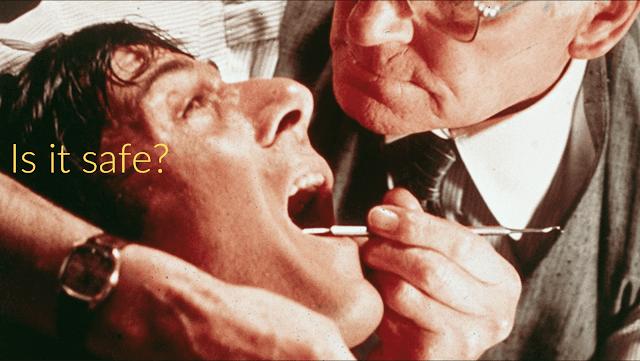
In this iconic scene from Marathon Man, Lawrence Olivier drills into Dustin Hoffman as he grills "is it safe?"

Is it Safe?

This is a line we all need to be stealing from Lawrence Olivier, and repeating like a mantra as we parse through vaccine information and attempt to make sense of it all.  

Biden assures us it is.  Let's see if the experts agree. 

A Dry Run

The doctors concur that the vaccine is an experiment, at best.  In their own words:

Gene based vaccines have never been used on humans before.  So what we’re witnessing now are human experiments. Experiments.  On.  Humans.  The amazing point—if you want to do animal experiment in the US, you have to file an application for this, you have to put the whole case on paper, pages and pages…then you have a committee who goes through every word and in the end they will say ‘yes’ or ‘no’.  Now what have we seen here?  Experiments on thousands and thousands of humans in the world, that have not gone through ANY examination as to if they may be dangerous to you.  Dr. Bhakdi Sucharit 

We call these vaccines, but they clearly are using off the term investigational vaccines.  And we are asking people to be subjects in an experiment on humanity.  This is a large phase 3 trial.  Dr. Ryan Cole

Everyone who is getting these vaccines is part of an experiment that we are running—that is actually wildly over-generous to say because for it to be an experiment, we would have to systematically collect data on what happened to them, and in fact our systematic system isn’t so systematic….it’s voluntary reporting with stigma attached.  Dr. Bret Weinstein 

There haven’t been any mRNA vaccines in other creatures.  We are the first creatures that it’s been tried to.  Dr. Malone, inventor of the mRNA vaccine 

In conclusion?  By the very definition of "experiment", we cannot know at the onset if the vaccines are safe.  That's the discovery we're about to make.  Now where did Biden clarify this in his speech? 

When Will We Know if it's Safe?

As Dr. Weinstein pointed out, the rollout of this experimental vaccine in no way follows the protocol of scientific method.  So, in a sense, the real answer is: NEVER!!! 

However, the doctors have commented on the effects they're currently seeing, and long-term effects it's feasible they may see. 

We do not know the long-term side effects.  We usually don’t see those for 2, 3, 4, 5 years. 

As a hardcore scientist, I’m not political, I look at data, and when I look at data, I’m already seeing the adverse affects to these shots in a laboratory setting....I'm seeing an uptick of herpes family virus, shingles, mono, a huge uptick in human papilloma virus.  What it tells me is that the immune status of these individuals who got the shot is weakened.  We’re seeing a 200x increase in young men in inflammation of the heart above the baseline; what we’d see in North America.  Once your heart is damaged, it’s damaged for a lifetime.  Your heart cells don’t grow back.  Dr. Ryan Cole

Reproductive risks don't always manifest in the first generation.  I don't mean to scare, but I do mean to speak honestly and with integrity.  The honest position is: if you were to ask me: 'do you know what the reproductive consequences are?'  I have to tell you; 'No I don't because we don't have the data.' 

And if you then asked me; 'Have there been any examples in the past of reproductive effects of agents in female's reproductive tissue that were not anticipated by the animal model testing?'  I would have to say  'Yes, there is'.  Doctor Malone

The D-word

And what about the D-word that the White House has been mute on? And that Biden glossed over when he informed the nation that the vaccines were perfectly safe?  How many people have actually died from the vaccine? 

According to VAERS; Vaccine Adverse Effect Reporting System, at the publication of this blog post, over 14,506 people have died from the vaccine!  

In this excellent video, Steve Kirsch points out that VAERS compiles its data from voluntary reports, so the actual number of deaths is much higher.  And that normally a trial vaccine is immediately STOPPED after 250 deaths!  

Wow.  This perfectly safe vaccine has actually caused so many deaths that it should trigger a STOP per standard vaccine protocols.  

I guess what Biden meant to say is, outside of the 14,506 who have died from the vaccine at the time of his speech (a conservative number), and those who are and will be experiencing adverse effects, it's perfectly safe. 

The ONLY Solution?  Really?!?

Biden emphatically claims that the vaccine is the only real solution to ending the pandemic.  The doctors, armed with scientific studies and boots-on-the ground experience, do not concur. 

Dr. Perry spoke eloquently before the Senate in December of 2020, pleading for the use of ivermectin for prophylactic and early covid treatment. 

I am speaking on behalf of the organization that I am part of. We are a group of some of the most highly published physicians in the world.  We have 2,000 peer reviewed publications among us. 

There is a drug that is proving to be of miraculous impact. That is based on mountains of data that have emerged in the last three months. 

How can we tell when something is working?  There is only one answer to that: one of the central tenants of science, you need a control group.  You need a group comprobable to those you treat, and those you don’t treat.  We now have 11 randomized controlled trials.  Every one one of those trials shows in the ivermectin treated group, lives are saved, there is less need for hospitalization, less case counts.  We have the data. 

Ivermectin should be the standard of care for this based on these data.  3.7 billion doses have been administered since it was developed since 1987, over 60% of sub-Sahara Africa takes it on a yearly basis.  It has an unparalleled safety profile with almost no side effects….You cannot come up with a credible argument to not use it.

Dr. Ryan Cole corroborates: 

Some of these earliest treatment medications are the safest medicines on the plant.  One of them has been around what, four decades?  The other almost seven decades...and we have foolish physicians saying, 'oh, I need a placebo trial' and really it’s: 'look: it’s a sugar pill if it doesn’t work, a lifesaver if it does.'  And we're ignoring real science because out of 19,000 patients and studies on ivermectin and 26, 29 randomized controlled trials, there is a one in four quadrillion chance that this medication does not have an effect in improving the outcomes in Sars covid-2. ‬

Dr. Zelenko, at the beginning of the outbreak, treated thousands of patients in Orange County, NY.  In this video, at the beginning of the outbreak (March 2020) he had this to say: 

I'm seeing a tremendous outbreak in this community.  My estimates are more than 60% currently have covid.  I have been treating them with hydroxychlorquine, the other with the vitamin zinc in the pre-hospital setting.  The idea is to keep them from the hospital because we are running low on respirators.  I'm seeing tremendous positive results, I have not sent any patients to the hospital yet, even through I have treated hundreds already. 

How Bizarre

It beggars belief that with so much expertise, data and scientific studies, Biden would really claim that an experimental vaccine is the only solution to ending the pandemic. 

Dr. Bret Weinstein highlights this suspicious behavior:

Our policy is, despite all the data, if you come into my hospital and you’ve got all the signs and symptoms and a PCR diagnosis, the ER tells you, 'I’m sorry, Mrs. Smith…..you need to go home and incubate'….without giving you a drug that would undoubtedly make you better.  We are behaving in a way that propagates the pandemic.  The behavior is bizarre. 

Perhaps concealing this solution in plain sight gets at something Doctor Cole said (he is referencing page 3 of the FDA's Emergency Use Authorization for Vaccines to Prevent Covid-19): 

‪ If there were a treatment for this virus, they cannot have authorization for these vaccines.  Period. 

Was the vaccine where they wanted to get us to all along?

KIDS?!?

Biden's telling us to get our twelve-year-olds vaccinated, and encouraging research into vaccinating younger children.  The doctors, on the other hand, unequivocally, emphatically, vehemently stressed the pointlessness and danger of dispensing this vaccine to children.

Regarding children: the only reason you would treat a child is if you believe in child sacrifice.  Otherwise, there is no necessity.  Anytime you evaluate any therapeutic, you need to look at it from 3 perspectives: it is safe, does it work, and do you need it?  There has to be a medical necessity.  You look at the CCD, the statistics for children under the age of 18, there is a 99.9% survival rate with no treatment.....if you have a demographic that has no risk of dying, why would you inject them with a poison death shot?  Dr. Zelenko

‪Don’t let your child near these shots.  Again, we don’t know long-term effects: auto-immune, cancer, fertility.  Any university that is mandating these for their children, that is criminal.  These young healthy individuals are at no risk for death for this virus. ‬ Dr. Ryan Cole 

If there’s more risk, then the people who get no benefit really shouldn’t be involved.  Kids should not take it, because they are fairly well protected against covid.  Dr. Weinstein

Given that it's experimental, we don't know the effects, and it's totally unnecessary, it's really so, so sick that Biden would advocate children receive this vaccine--even those under the age of 11! 

It's Just the Right Thing To Do

Biden says the vaccine is so fundamental to being a decent human being that the vaccinated are entirely justified targeting righteous anger at the unvaccinated. 

The doctors say contraire mon frère.  And that in fact, it's unethical at best to mandate an experimental vaccine without knowing and disclosing the full risks. 

In their own words: 

There are three fundamental principles in Western bioethics: full and complete disclosure of risks, enduring comprehension of risks of those who will be taking the product, and willing consent.  Dr. Malone

‪We need to be hyper cautious about what we’re doing...to coerce someone into an experiment in order to keep gainful employment...it’s a violation of all medical ethics.  This is pure malfeasance.  It’s immunologically illogical to do something of this sort...we’re doing something that’s anti-science. ‬ Dr. Ryan Cole

Wake up.  This is WWIII.  This is a level of malevolence or malfeasance that we have not seen probably in the history of humanity.  There is zero justification for using this death shot. Dr. Zelenko 

A Catholic Response 

Is the vaccine really safe, the exclusive solution to the pandemic, and the upright thing to do?  The analysis provided by these doctors make Biden's claims flat and unconvincing at best.

How does a Catholic respond? 

With respect to human experimentation, the Catechism states:

Experimentation on human beings is not morally legitimate if it exposes the subject's life...to avoidable risks. Experimentation on human beings does not conform to the dignity of the person if it takes place without the informed consent of the subject.  (2295)

On the current US stage, many are taking the experimental vaccine simply to keep their job.  That's coercion, not consent.  Additionally, as the doctors have made clear: we cannot be entirely informed of the dangers because the dangers are not yet known, nor are they being systematically or scientifically studied.  However, we do know from the VAERS database that one possible side effect of the vaccine is death.  

Per the catechism, then, this experimental vaccine isn't morally legitimate.  

The Catechism further states:

The citizen is obliged in conscience not to follow the directives of civil authorities when they are contrary to the demands of the moral order, to the fundamental rights of persons or the teaching of the Gospel.  Refusing obedience to civil authorities, when their demands are contrary to those of an upright conscience, finds its justification in the distinction between serving God and serving the political community.  (2242) 

Given that the vaccine isn't morally legitimate, a Catholic is entirely justified—no, really obligated—to oppose  civil authorities with respect to the vaccine and vaccine mandates.  It's entirely opposed to the dignity we possess as children made in the likeness and image of God. 

What form will this civil disobedience take?  It remains to be seen, but we're certainly witnessing a strong initial response.

And You?

What is your experience with the vaccine?  Are you comfortable with being the subject in medical experiment?     

Share:

7/21/21

Perfect Detachment: Reflections on the Wedding at Cana

Have you ever told a child they’ll go to the park in the afternoon, only to find, when 2:00 rolls around, that it’s raining, or you’re stuck in traffic, or need to make an unexpected errand?

And suddenly you’re dealing with a meltdown messier than an ice cream cone on a scorching day.

Wedding at Cana 

The Catechism tells us not to put too much store in future events.

“a sound Christian attitude consists in putting oneself confidently into the hands of Providence for whatever concerns the future, and giving up all unhealthy curiosity about it.” 1 

And from the Gospel of John, it’s clear Jesus Himself didn’t entirely understand how events were to transpire in his own life. 

In the story of the wedding feast at Cana, Mary approaches Jesus to let him know they’ve run out of wine.  In response, He says:

“Woman, how does your concern affect me? My hour has not yet come.”  John 2:4

Yet we know how the story turns out: Mary tells the servants to do whatever He tells them, and Jesus turns water into wine: a superior wine in fact to the one the guests had been drinking.  John cites this as the beginning of Jesus’ signs. (cf. John 2:11)

Jesus clearly had some notion about when his public ministery would begin.  Had He decided this for Himself?  Or received some assurance in prayer?  

We can’t know entirely what He meant by this statement, but that He didn’t intend to making a spectacle at the wedding. 

Yet He’s able to reassess his plans in the space of an instant and bring about this wondrous miracle. 

What About Me?

If Jesus wasn’t granted perfect clarity around the events of his life, it’s safe to assume (indeed we all well know) that we aren’t either. 

Or, to be more precise, we can also, like Jesus, anticipate that events will transpire in our life quite differently than we plan. 

Perhaps we’re talented, yet stuck in an uninspiring job, or have been passed over for a deserved promotion.  Or maybe we anticipated marrying and having a family, but instead have lived our adulthood single.  Or feel we entered into a perfect marriage only to find it now ending in divorce. 

If only Jesus could turn the bland waters of our disappointment into wonderful fruity wine! 

And speaking of weddings—remember that character Miss Havisham from Dicken’s Great Expectations?  After being jilted at the alter, she wandered around her ruined mansion for decades, dressed in her white wedding gown.

Although she’s a bit exaggerated, many of us probably relate to her disappointment and disillusionment.  And we creep around in a wedding dress of unrealized hopes and expectations, unable or unwilling to marry our expectations with the reality of our present circumstances. 

Jesus, in this Gospel story, demonstrates a more excellent way: one of simply accepting circumstances as they play out in the present moment, regardless of what we’d hoped for or planned.  And a readiness to adapt to what seems most appropriate to the situation at hand. 

Ok, But How Did He Do It?

It’s very easy to watch Jesus behave with perfect detachment.  But as for emulating—that’s another story.  As for me, I’m way more likely to behave like a toddler having a meltdown when things don't play out as I think they should, or as I think I deserve.  

In the sermon on the Mount, Jesus tells us “Where your treasure is, there also your heart will be.” (Matthew 6:21)

In other words, if we're thrown off center or cripplingly disappointed over unmet expectations, it may reveal that we have placed our treasure in something other than God alone. 

Miss Havisham, clearly, had an inordinate attachment to marriage. And perhaps we, too, have similar attachments: to a career, reputation, respectability, expectations around family, or simply to having control over our own time and schedules.

Jesus, rather, said that He seeks only to do “the will of the one who sent me.” (John 5:30).  And that is where he found His center, His peace.  So He wasn’t inordinately shaken or discombobulated when his mother tells him to perform a miracle, upsetting his plans.  Rather, he saw it at a moment of further discernment. 

How Do I Do It?

How do I let go of attachments?  Recognizing that you have them is an important first step.

The Catechism tells us how to remedy distraction in prayer; by “turning back our hearts, for a distraction reveals what we are attached to.” 1 

Perhaps, similarly, we can do the same towards our lives: as hard as it may be to accept the present circumstances, turn our hearts back to Jesus, and remind ourselves that as a disciple of Christ, we really seek only to do His will, and so we're indifferent to the particulars. 

This takes hard work to achieve such a centered, detached state of being. 

But the work, I can imagine, is well worth it.  As it allows us to celebrate the present moment and lose all anxiety about the future. 

What About You? 

How do you cope when your life doesn’t go as expected? 

And what are your thoughts or takes on the Wedding at Cana story?  It really provides a lot of room for thought--particularly regarding the role of the BVM.  More on that topic here! 


1 . Catechism of the Catholic Church.  Paragraphs 2115 & 2729.  April 1995.↩ 

Share: