Showing posts with label St. Teresa of Avila. Show all posts

4/8/22

When the Spirit Is Willing (But the Flesh Is Weak): Overcoming Acedia in Prayer

"To not go forward is to turn back and not to be gaining is to be losing."

~ Saint John of the Cross, The Ascent of Mount Carmel

Do you ever put something off, claiming you don't have the time for it, but really you're avoiding it because it's a lot of work? Decluttering my desk falls into this category. Sometimes it's something much bigger, like changing a job or moving.

About a year ago, I spent a weekend at a cabin. Determined to fit in some screen time, I managed to make sense of four remotes and two DVD players. While digging through mounds of DVDs, I pulled out the indie musical, Once.

Did you see this back when it was all the rage? I recall listening to the passionate yet somewhat depressing soundtrack on our car cassette player (this movie is THAT old), and even saw the musical on Broadway, where two kids squirmed behind us the entire time. 

For a new spin this time around, I decided to watch it with the director commentary. And I discovered the whole movie is about this notion of inertia and stagnation. As director John Carney puts it:

The title “Once” refers to a male condition not particular to Ireland but it's certainly prevalent in Ireland; a lot of guys that I know are very talented and have a lot to say about the world and are witty and urbane and funny...and are very creative people but they just don't have the kind of “get-up-and-go.”

You hear that line a lot with these people: “Once I get enough money,” “Once I get out of my parents' house,” or “Once I get this little business set up,” or “Once I get my great script written, then I'll be brilliant.”

But they're not actually doing it. 

It's the guy hiding behind the pint of Guinness who could be great but just keeps putting it off and keeps procrastinating.

We've all met this guy. He’ll tell you about an unrealized dream to own a nightclub and DJ on Ibiza, but currently, at 45 years old, he’s still sleeping in his childhood bedroom. It's how my BFF, who has a penchant for drinking three pints of beer in lieu of lunch (while telling you of his plans to explore the Amazon), describes himself: “I drink and I know things.”

As it turns out, this sort of sloth doesn’t only apply to life: it’s also a central challenge in prayer. 

Many people--including lifelong Christians--think a fertile spiritual life is reserved exclusively for those endowed with that “special charism” for mysticism (as though there were such a thing!). But prayer, really, is so basic: it's about speaking with and developing a relationship with the One who created you. So a strong spiritual life is well within anyone's reach.

One actual stumbling block to achieving spiritual maturity, however, is that it's hard. Particularly at the beginning stages, prayer feels like that line from Ezekiel: “The days drag on, and no vision ever comes to anything.”1

Fortunately, when we understand what to expect at various stages in prayer--and appreciate the benefits of moving into what St. Teresa of Avila calls the interior mansions--it's easier to resist a compulsion to throw in the towel. 

Let's look at what this expert on prayer says about starting out on this supernatural journey, and then some ways to overcome temptations to acedia.

Our souls need a lot of weeding, tilling and fertilizing as we enter into
the first mansion of prayer, writes St. Teresa.

Prayer 101

In Interior Castle, the masterpiece on prayer that she wrote at the age of 62, St. Teresa of Avila describes the soul as a great mansion. The entryway to this castle is prayer.2

In The Book of Her Life, a spiritual memoir she wrote over a decade earlier, she uses the analogy of water and gardening to describe prayer. When we start out, entering into the first mansion, the soil is rocky and hard and full of weeds. We need to find water of our own initiative. And sometimes the well is dry!

Beginners in prayer, we can say, are those who draw water from the well. This involves a lot of work on their own part, as I have said. They must tire themselves in trying to recollect their senses. Since they are accustomed to being distracted, this recollection requires much effort.3

(Generally speaking, I'd say she is talking about mental prayer; that is, sitting and meditating in silence on a scripture passage or something.)

This beginning phase can last a while; for St. Teresa it lasted for years. (But she stresses that God takes every soul on a different journey.) Anyone can press on to the interior mansions, however, where God provides the water Himself: “God does not deny Himself to anyone who perseveres. Little by little He will measure out the courage sufficient to attain this victory.”4

However, it's really, really easy for acedia to set in before achieving this breakthrough. As St. Teresa says: “There are many who begin, but they never reach the end....thinking they are doing nothing, they become afflicted.”5

What is acedia exactly? The Catechism defines it as: “A form of depression due to lax ascetical practice, decreasing vigilance, carelessness of heart. 'The spirit indeed is willing but the flesh is weak.'“6

When we hit a wall in prayer; have a long spell of dryness or our mind constantly races and we can't stay focused for more than thirty seconds; it's easy to tell ourselves we don't have the time, it's pointless and there are many more important things to be doing.

St. Teresa, rather, tells us not to be concerned. “It is very important that no one be distressed or afflicted over dryness or noisy and distracting thoughts [in prayer].”7 Pressing on demonstrates that we desire the God of all consolations, rather than the consolations of God.

The Benefits of Prayer

The difficulty of prayer naturally begs the questions: Why does God make it so hard? Doesn't He want a relationship with us? And why would anyone press on into the interior mansions? St. Teresa offers some explanations:

His majesty does not desire that we enjoy something as precious as this without paying a high price.8

The favors that come afterward are of such great worth that He desires first that before He gives them to us we see by experience our own worthlessness so that what happened to Lucifer will not happen to us.9

(What happened to Lucifer? I think he committed the sin of pride, which resulted in a total separation from God, and since he's an angel there's something about his intellect that makes the decision irreversible.)

Now, about some of these favors “of such great worth”....what are some benefits of pressing on?

  • A Solid Spiritual Foundation

By consistently spending time with God--during times of plenty and times of drought--St. Teresa says we establish a strong spiritual foundation. Even through we travel in darkness, and over what seems like a barren land, we really cover some ground over a period of time.

The soul that begins to walk along this path of mental prayer with determination and that can succeed in paying little attention to whether this delight and tenderness is lacking or whether the Lord gives it (and whether it has much consolation or no consolation) has travelled a great part of the way.10

  • God's Voice is Clear(er)

Just as with a person, when you spend a lot of time with God, you become more familiar with Him. The noises of the world fade away, and it becomes easier to recognize Him in your day-to-day.

This benefit is really a central reason to pursue a life of prayer, as there is So. Much. Noise. in the world, and SO MANY blind guides (including not a few leaders in the Church). Developing the ability to identify and listen to God on our own has become a necessity to any disciple of Jesus.

  • God Becomes Our Friend

Have you ever had the kind of boss who tells you exactly how much cream he wants in his coffee, and who puts you on edge every time he walks into the room?

When we're not familiar with Him, it's easy to feel this way about God. However, Jesus calls us his friends at the Last Supper; this is the sort of relationship God really desires to have with us. 

St. Teresa says that as we press on in prayer, this “servile fear passes away”11 and the dynamic of the relationship becomes more casual and friendly.

  • Inner Peace

“What hope can we have of finding rest outside of ourselves if we cannot be at rest within,” St. Teresa writes in Interior Castle.

In the Sermon on the Mount, Jesus tells us that God knows and can provide for all our needs before we ask. A strong prayer life increases our trust in His providence, and we experience less anxiety and strife.

Clearly, there's incentive to press on past the ennui and the sluggishness you might feel in prayer. As St. Teresa says, “all (a soul's) good is within this castle.”12

5 Ways to Overcome Acedia

Acedia is similar to feeling stuck. At times, the temptation to give in feels irresistible.

According to Newton's law of motion, an object at rest stays at rest, and an object in motion stays in motion. Our prayer lives are no different. Taking the right action gets us moving and creates the momentum to progress onto the next mansion.

If you're struggling to continue with prayer and feel that nothing ever happens, here are some ways to fight the inertia.

1. Seek Out Support and Enrichment

In our secular society, finding spiritual companions is tricky business. Or maybe you know a lot of Christians, but you don't connect with them.

Like-minded people are out there for sure, however. Pray to the Holy Spirit and do some digging: maybe go on a retreat or seek out a spiritual director. One or two companions may emerge.

If no one materializes, accept that this is where God wants you (much of a spiritual life is done in solitude). Instead, seek out a book on prayer; the Carmelite mystics have written some good ones, including Story of a Soul, Interior Castle and the Ascent of Mount Carmel. You can ask these saints to guide you, too, as you read: they'll be right by your side encouraging you along!

2. Tell Yourself the Right Message

I'm gonna go all Tony Robbins for a moment here and point out that our brains are wired to realize and perceive whatever we tell them. Telling ourselves “This is impossible,” and “I am not good at this” are dead-end messages that easily lead to discouragement and defeat.

It's important to deliberately shape the messages we tell ourselves about our prayer lives. As St. Teresa points out, God wants our wills, and so simply making an attempt to pray is success in His eyes. When we remind ourselves of this, it's possible to perservere through dryness.

3. Create a Routine & Keep Showing Up

Growth happens in the day-to-day, so long as we create the space for it. Routinely showing up to pray allows things to happen.

When we find a place and set a time; say stopping by an empty church for 30 minutes after work, creating a designated space in our home, or even finding a quiet place in a nearby park where we're sure to find solitude; it creates the possibility of progress in prayer. Many parishes have Chapels of Perpetual Adoration: these also are excellent places for quiet prayer.

The water may only trickle at first, but if we pray habitually, eventually we'll see change and growth.

4. Find Your North Star

Before the invention of the magnetic compass, ships couldn't navigate on cloudy nights. Rather than getting miles off course, they'd put up anchor until conditions cleared up.

Similarly, in our prayer lives, it's hard to move through periods of dryness and distraction when we have an incoherent idea of where we're going.

Focusing on the benefits of spiritual maturity (outlined earlier) allows the fog of uncertainty to evaporate. Even amidst darkness, we're able to move forward with confidence.

5. Be Patient With Yourself

As we know all too well, falling and failing is a given in everyone's life. Prayer is no different. Anyone who sets out will backslide.

Perseverance, as discussed, is part and parcel to growth in prayer. “There is no other remedy for this evil of giving up prayer than to begin again,”13 writes St. Teresa.

However, it's counterproductive to berate ourselves for falling. Sometimes, allow yourself to press pause, knowing you'll get your head back in the game the following day.

Conclusion

One thing that struck me from watching Once (for the tenth time or so) is this idea that life is about living. We aren't meant to remain in a stagnant space of unfulfilled potential. The two central characters provided each other the impetus to achieve breakthrough in their musical careers and personal lives.

We all have those days where we sleep for ten or eleven hours, hit snooze a billion times, then spend the rest of the day sitting on the couch eating pizza. And our prayer life hits these kinds of lows, too.

The thing about prayer is that you don't need to be “good at it” or “doing it right.” You can be distracted. You can feel like you're doing nothing. The key is to keep doing it. And when we break through that wall, it allows God to water our lives with greater peace and knowledge of Him.

What's your experience with dryness in prayer? Is it a phase? Or something that recurs with you all the time?

🍃

1 Ezekiel 12:22. 

2 Volume 2: The Collected Works of St. Teresa of Avila. Translated by Kieran Kavanaugh, OCD & Otilio Rodriguez, OCD. ICS Publications, 1976: Page 283, 286.

3 Volume 1: The Collected Works of St. Teresa of Avila. Translated by Kieran Kavanaugh, OCD & Otilio Rodriguez, OCD. ICS Publications, 1976: Page 81.

4 Volume 1: The Collected Works of St. Teresa of Avila: Pages 79-83.

5 Volume 1: The Collected Works of St. Teresa of Avila. Page 84.

6 Catechism of the Catholic Church. Doubleday Publishers, April 1995: Paragraph 2733.

7 Volume 1: The Collected Works of St. Teresa of Avila. Page 85.

8 Volume 1: The Collected Works of St. Teresa of Avila. Page 79.

9 Volume 1: The Collected Works of St. Teresa of Avila. Page 83.

10 Volume 1: The Collected Works of St. Teresa of Avila. Page 83.

11 Volume 1: The Collected Works of St. Teresa of Avila. Page 78.

12 Volume 2: The Collected Works of St. Teresa of Avila. Page 300.

13 Volume 2: The Collected Works of St. Teresa of Avila. Page 303.

Share:

3/15/22

How (and Why) to Make a General Confession

“You're only as sick as your secrets.” ~ Alcoholics Anonymous

“Though your sins be like scarlet, they may become white as snow.” ~ Isaiah 1:18 

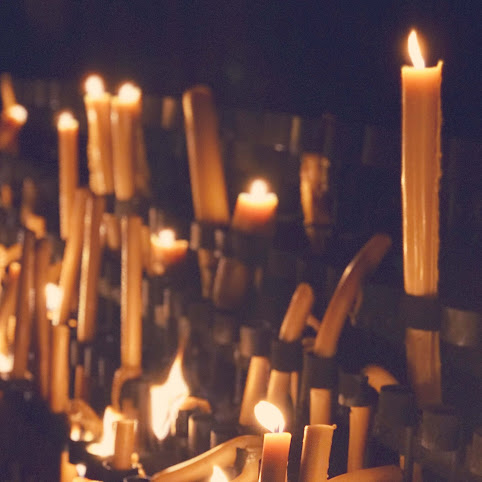
Candles at the Fatima Shrine in Portugal.

“What do you see when you're in the dark, and the demons come?” Mitch Leary (John Malcovich) asks Frank Horrigan (Clint Eastwood) in a creepy late night phone call in the 1993 movie In the Line of Fire. Eastwood, a secret service agent, failed to take a bullet for President Kennedy on that fatal day in Dallas, and the assassination haunts him to the present day. “Do you really have the guts to take a bullet, Frank?” Malcovich further taunts him in the brilliant, gripping screenplay by Jeff Macguire.

And what do you, reader, see when you're in the dark and the demons come? 

We all have a personal legion of demons who come to agitate and rattle us about ways we've messed up, people we hurt, things we should or should not have done--and who remind us that the windows of opportunity to repair the damage closed long ago. Living with them is a heavy burden. It destroys our peace.

Jesus wants to exercise these demons from us, give us his peace, and restore us so we can live in the fullness of life. 1  And he has the unique capacity to do so. 

One principle means to achieve this restoration is with the sacrament of Reconciliation. 

A central problem for many, though, is that confession is SCARY!!! Who really wants to go into a tiny room and tell a priest her or his deepest and darkest? 

And if confessing sins from the last few months isn't hard enough, the notion of making a general confession, where you confess the sins of your entire lifetime, is downright terrifying. 

If this echoes some of your sentiments regarding confession, you certainly aren't alone. Many, many forgo receiving the sacrament of Penance due to its awkwardness, or else they just don't see the point of it. 

The reality, however, is that making a confession is healthy and natural. As a sacrament, it's one of the “masterworks of God.” 2 And you needn't squirm over feigned awkwardness: the priest has heard it all before. 

Let's look more closely at the benefits of regular confession and why a general confession especially makes sense at this moment in time—then go over some practical ways to prepare for one. 

A Routine Cleansing 

Over lunch last summer, my friend told me that he only makes a confession once in a while, when he's done something particularly injurious that he's truly sorry about. 

This is pretty much on base with what the Church professes: 

“After having attained the age of discretion each of the faithful is bound by an obligation faithfully to confess serious sins at least once a year.” 3 

For my own part, I had an experience that convinced me I need to make confession a regular part of my life, regardless of whether or not I think I've done something “really bad.” 

Several years ago, I'd really had it with the priests and parish communities where I lived and decided to take a long break from confession. One night, I had a dream that I was in a filthy bathroom. A layer of dirt covered every surface area. It gave me the creeps just to be standing in the midst of it; like one of those gas station bathrooms that hasn't been cleaned for months and months. Then, a friend found me and guided me downstairs into a perfectly clean, sparkling and fresh bathroom. 

The next morning, a friend called and said that she was going to confession that afternoon and wondered if I wanted to join her? 

I was so surprised at this phone call; we never had “confession dates” before, lol; and I definitely made a connection between my dream and her invitation.

In the dream the bathroom represented my soul. Everyday sins dirtied it, so much so that even over a short span of time, it became unbearably filthy. Keeping my soul clean entailed a regular cleansing; i.e. confession. 

So after that, rain or shine, happy or sad with the priest or parish, and regardless of whether or not I thought I'd done anything exceptionally horrible, I made a practice of going to confession regularly. As a rule of thumb, I try to go about as often as I clean my bathroom. 😉

The Catechism on Confessions

Do you ever put something off for days and weeks, and over that time it just festers and gets worse? Take cleaning out your refrigerator. If it's not done regularly, all sorts of filth starts to grow onto leftovers and what not. Sometimes, nipping an ugly task in the bud is the easiest way to resolve it. 

The sacrament of Penance is a lot like that. In 1 John 1:9, John tells us, “If we acknowledge our sins, he is faithful and just and will forgive our sins and cleanse us from every wrongdoing. If we say, 'We have not sinned,' we make him a liar, and his word is not in us.” 

Looking at the ways we've failed is hard. However, a confession has a healthy psychological benefit: it's facing up to what we've done, which enables us to move past it. Here's how the Catechism phrases it: 

“The confession (or disclosure) of sins, even from a simply human point of view, frees us and facilitates our reconciliation with others. Through such an admission, man looks squarely at the sins he is guilty of, takes responsibility for them, and thereby opens himself again to God and to the communion of the Church in order to make a new future possible.” 4 

Essentially, confession allows for greater spiritual maturity. As the priest said in his homily at the Ash Wednesday Mass I attended: “If you go to confession regularly, you will experience spiritual growth. Guaranteed.” 

The Benefits of a General Confession

A general confession, which entails summarizing the sins of your entire lifetime, has been a tradition in the Church for some time now. St. Therese of Lisieux writes about making a general confession at her Carmel in France. 5  And the first section of St. Ignatius' Spiritual Exercises includes preparing for a general confession. 

But what is the sense in making one; of re-confessing sins you've already received absolution for in previous confessions? At first blush, it reminds me of a story a friend of mine told me of traveling to Lourdes with his family as a little boy. Although the intention of the trip was to seek healing for his ailing sister in the Lourdes water, upon arrival the volunteers at the grotto recommended he be dipped into the water as well. 

“But I'm already well,” he pointed out.

“But you will be better,” they insisted.

The notion of asking forgiveness for a sin more than once seems like a failure to trust or believe that Jesus wiped the slate clean the first time. 

--Add to it that it's just so dang hard to acknowledge an entire lifetime of sins in one sitting. 

Although a Catholic is under no obligation to make a general confession, there are in fact several good reasons for doing so—particularly at this point in time: 

  • In his Spiritual Exercises, St. Ignatius lays out some clear benefits of a general confession. For starters, he says it generates a greater contrition for all the sins of one's entire lifetime.
  • Another benefit he cites is that it increases our self-knowledge. We come to a greater understanding of our weak areas and tendency to sin, which allows us to heal. And it also shows us those areas where we've already healed and grown. 
  • And finally, he says that a general confession makes one better disposed to receive the Blessed Sacrament. And this in turn creates fortitude to no longer fall into sin. 6 
  • A final reason to make a general confession at this moment in time is to prepare ourselves for the Illumination of Conscience. As I've written several times before, the Illumination is unique in all of human history. It is a special moment in which God will reveal to every person his or her individual transgressions over an entire lifetime. Due to the Blessed Virgin's prophecies at Garabandal, there is good reason to think this Illumination will take place very soon; it's to happen, she says, when the world returns to the spirit of communism. Receiving this judgment will be a lot for any of us to palate, and making a general confession would mitigate the difficulty of this experience.

Appreciating these benefits of a general confession serves to ease the challenge of making one. And although not exactly being “men of the world,” most of the priests I've confessed to have been reasonable and easy enough to talk to. It's really expected of him, as the Catechism says: 

“The minister of the sacrament should....have a proven knowledge of Christian behavior, experience of human affairs, respect and sensibility toward the one who has fallen.” 7  

When I made a general confession, it was at a parish with an ENORMOUS line at the confessional. I honestly thought the priest would turn me away when he realized I was making a general confession, saying that he didn't have the time. But he didn't. And it was hard, but I stayed focused on what I was ACHIEVING from the confession: some sort of release and spiritual preparation for this upcoming decade. 

Now let's look at how one might prepare for a general confession—fortunately St. Ignatius has provided a coherent step-by-step guide.

St. Ignatius' Exercises to Prepare for a General Confession

As a young man in Spain around the turn of the 16th century, St. Ignatius of Loyola developed distinctive spiritual practices while praying alone in a cave for several months. After starting the Jesuit order around 15 years later, he codified these exercises, and novitiates complete them upon entering the order.

The term “spiritual exercises” encompasses a range of spiritual activities, including examination of conscience, meditation, contemplation, vocal and mental prayer. (Although the exercises, traditionally, are completed over a retreat lasting as long as thirty days, they can be adopted to any practitioner, over any time range that suits him or her.) 

Discernment is central to the exercises: identifying those desires and experiences in our lives that come from God, those that are from the devil, and those that originate from ourselves. This enables one to navigate a path toward God and the fullness of life Jesus promised us. 

The beginning of his exercises is dedicated to the contemplation of sin and preparation for a general confession. 

  • The Five Preparatory Exercises

In preparation for making a general confession, St. Ignatius suggests removing yourself from your daily life as much as possible. This way, to use his words, “The mind is not engaged in many things, but can give its whole attention to one single interest, that is, to the service of its Creator and its spiritual progress.” 8 

He lays out five separate exercises, 9 which I've simplified and summarized below. He recommends performing these exercises over the course of one day: the first exercise at midnight, the second upon rising, the third before or after Mass (before lunch), the Fourth at Vespers (early evening), and the Fifth an hour before supper. 

Since these were written in first person, I'm summarizing them here in first person as well. 

The First Exercise

I begin with a prayer asking God that this exercise might be oriented toward him. 

Next I complete two preludes:

First I meditate on “sin.” A visual Ignatius offers is a knight coming before a king and court after he's done something shamefully wrong, and after the king has given him many favors. (This visual gets at the kind of person Ignatius was.)

Second, I ask for the grace to be ashamed of occasions of sin. 

The body of this exercise entails meditating on the single sin of the angels that caused them to be cast into hell and the single sin of Adam and Eve that brought about the fallen state of the entire human race. 

Then I consider those who've led far better lives that I, who've sinned far less, yet who have incurred punishment and damnation.

Finally, I close with a Colloquy (which is basically a natural conversation with Jesus): After meditating on Him on the Cross, I answer these questions:

“What have I done for Christ?”

“What am I doing for Christ?”

“What ought I to do for Christ?”

The Second Exercise

The second exercise begins with the same preparatory prayer. 

This is followed by a prelude, this time asking for the grace of intense sorrow for sin. 

Next I record my sins, going over my life year by year, focusing on where I lived, my dealings with others and the positions I held. I look at my sins altogether, and then I look at myself compared to the almighty God. I look with awe on all of creation for having permitted me to commit these sins: the angels “through they are the sword of God's justice,” other humans, the saints, all of nature. 

Finally, I end with a Colloquy, speaking to God and thanking him for his mercy. 

The Third Exercise

The third exercise begins with the preparatory prayer. 

Next, I repeat the first and second exercises, focusing on which aspects bring consolation, and which desolation. 

I finish with three colloquies, speaking first to the Blessed Virgin, asking for her to help with self- knowledge and re-ordering my life, and to distance my life from worldly dangers. Then I make the same requests of Jesus and God the Father. 

The Fourth Exercise

The fourth exercise repeats the third, like a cow chewing on its cud, and closes with the same colloquies. 

The Fifth Exercise

The fifth exercise begins with the preparatory prayer.

Next, I meditate on hell, using all the five senses: seeing, hearing, smelling, tasting, and feeling the flames. 

One helpful description here is from St. Teresa of Avila's Book of her Life, a spiritual memoir she wrote around the age of 50. 

While I was in prayer one day, I suddenly found that, without knowing how, I had seemingly been put in hell….the entrance it seems to me was similar to a very long and narrow alleyway, like an oven, low and dark and confined; the flow seemed to me to consist of dirty, muddy water emitting a foul stench and swarming with putrid vermin. At the end of the alleyway a hole that looked like a small cupboard was hollowed out in the wall; there I found I was placed in a cramped condition.

All this was delightful to see in comparison with what I felt there….What I felt, it seems to me, cannot even begin to be exaggerated, nor can it be understood. I experienced a fire in the soul that I don’t know how I could describe. The bodily pains were so unbearable that though I had suffered excruciating ones in this life and according to what doctors say, the worst that can be suffered on earth…these were all nothing in comparison with the ones I experienced there. I saw furthermore that they would go on without end and without ever ceasing.

This, however was nothing next to the soul’s agonizing: constriction, a suffocation, an affliction so keenly felt and with such a despairing and tormenting unhappiness that I don’t know how to word it strongly enough. To say the experience is as though the soul were continually being wrested from the body would be insufficient, for it would make you think somebody else is taking away the life, whereas here it is the soul itself tears itself in pieces.…..I felt myself burning and crumbling; and I repeat the worst was that interior fire and despair….

the Lord wanted me to actually feel those spiritual torments and afflictions, as though the body were suffering. 10

(St. Ignatius of course doesn't include this excerpt in his exercises, but I have found it's a pretty thorough description, and so helpful for a meditation.)

Next, I ask for a sense of pain that the lost suffer, and for a fear of hell, an appreciation of its reality as a motivation to live an upright life.

I close with a colloquy, talking with Jesus about those who are condemned, and thanking Him that he's been merciful to me. 

And that wraps up the five exercises: after completing these, anyone is pretty well prepared to make a general confession. Most priests are available to hear confessions at least once a week. 

St. Ignatius makes a few comments on penance. 11 He suggests giving up food, sleep, and practicing forms of asceticism that make you uncomfortable but that don't hurt you physically (like taking cold showers, for example). He says that identifying suitable penance is a discernment process, and recommends talking over with God what is best for you. 

A Lesson From the Three Little Pigs

My two-year-old nephew has an indefatigable obsession with the story of the three little pigs, and last summer I read it to him over and over again. And yes, at the risk of being unbearably banal, I am going to go here: I found that it offered a powerful spiritual lesson. 

Although from one vantage a general confession seems intimidating, from another it's a wise thing to do. We all choose the foundations that we build our lives upon. Prudently laying a foundation of bricks fortifies us for the spiritual battles we face in this dark hour. 

Jesus assures us that his yoke is easy and his burden is light, and when we've cast all our cares upon him, and asked for His forgiveness, our reward is a light and carefree conscience.

But enough from me. What's your take on confession? Do you receive the sacrament regularly and believe it's beneficial? 

🍃


1 cf John 14:27, John 10:10.

2 Catechism of the Catholic Church. Doubleday Publishers, April 1995: Paragraph 1116 

3 Catechism of the Catholic Church. Doubleday Publishers, April 1995: Paragraph 1457.

4 Catechism of the Catholic Church. Doubleday Publishers, April 1995: Paragraph 1455.

5 Story of a Soul: the Autobiography of St. Therese of Lisieux. Translated by John Clark O.C.D. ICS Publications, 1996: page 149.↩

6 The Spiritual Exercises of St. Ignatius. Translated by Louis J. Puhl, S. J. Loyola Press, 1951: Page 24.

7 Catechism of the Catholic Church. Doubleday Publishers, April 1995: Paragraph 1466.

8 The Spiritual Exercises of St. Ignatius. Translated by Louis J. Puhl, S. J. Loyola Press, 1951: Page 10.

9 The Spiritual Exercises of St. Ignatius. Translated by Louis J. Puhl, S. J. Loyola Press, 1951: Pages 25-33.

10 Volume 1: The Collected Works of St. Teresa of Avila. Translated by Kieran Kavanaugh, OCD & Otilio Rodriguez, OCD. ICS Publications, 1976: Page 214.

11 The Spiritual Exercises of St. Ignatius. Translated by Louis J. Puhl, S. J. Loyola Press, 1951: Pages 38-9.

Share:

10/15/21

Simplicity & Beyond: Finding God in Present Moment

Fear lives in the psychological space where God is absent. Every second is a creation, an act of re-creation. God is recreating us and giving us the opportunity to be who He wills us to be. If you walk around with that thinking, you are never alone, and there is no space where fear can set in.   -Doctor Vladamir Zelenko

There is no fear in love, but perfect love casts out all fear. 1: John 4:18

Have you noticed how your outlook completely changes over the course of a week or two?

I had a friend call me out of the blue a few weeks ago and we talked for over two hours. Her call felt like someone reaching out and taking my hand in the midst of a dense, impenetrable fog.

I had been in my room crying the night before; the sense of nowhereness this pandemic had thrown my life was at an all-time high. Plus, I was feeling the consequences for not playing along and getting vaccinated. The hatred came from all directions; friends and family members, the state, and the media.

And then, a few weeks later, she called again. And I was amazed at how much my mind-set had shifted in that short space of time. My life had energy and clarity and momentum that had been completely absent three weeks earlier.

Without paying attention to the details of our lives, it's hard to account for these shifts.

Recognizing God in the Present Moment

According to Zelenko, in order to meet God, all we have to do is Be. Here. Now. Remaining in this recognition comes with a great incentive: we live without fear! (Do you walk around acknowledging that you're never alone?)

If God is right here, he probably isn't keeping entirely silent.

How do we recognize this voice? And what, if anything, does He ask?

It's So Simple 

Many Doctors of the Church profess the simplicity of God.  

You are simplicity itself.   -St. Augustine 1

The nearer one gets to God, the simpler one becomes.   -St. Therese of Lisieux 2

God is no wise composite, but is altogether simple. Every composite is posterior to its component parts, and is dependent on them; but God is the first being. Every composite has a cause, for things in themselves different cannot unite unless something causes them to unite. But God is uncaused.   -St. Thomas Aquinas 3

Simplicity, it appears, is a fundamental characteristic of this God who meets us here in the present moment.

This certainly provides clues on where not to look for God: in the complicated, the overwhelming, the confusing. Not in rambling words or complex thoughts.

How would a simple being communicate?

In all likelihood, with clarity. Startling, almost abrupt clarity. With direct words and phrases that get at the heart of the matter; Jesus often spoke like this.

And so identifying the simple in our day is one way to recognize God in them.

(As I've written about in a previous post, I think the simplicity of the Illumination of Conscience is one of the central reasons we can conclude it comes from God.)

It's Personal 

From my own experience and speaking to others, and from scripture, it's clear this communication is very intimate. Psalm 139 tells us:

Lord, you have probed me, you know me: you know when I sit and stand; you understand my thoughts from afar. My travels and my rest you mark; with all my ways you are familiar. Even before a word is on my tongue, Lord, you know it all.

People are drawn to different spiritualities (Ignatian, Carmelite, Franciscan, Benediction) and devotionals based on their personalities, preferences, and cultural heritage. Some take great stock in dreams, or journaling as a way to pray. For others, it's far more intellectual.

That is to say, a prerequisite to hearing God speaking in the present moment is, as the Delphic maxim says, to know thyself. 

Also, we can anticipate communication from God will be very, very intimate: closer than a good friend.

It Brings Quiet 

It's very hard to distinguish between thoughts or messages that come from ourselves and those that come from God. St. Teresa of Avila wrote about this at length, with respect to discerning locutions. However, I think her criteria applies across the board:

The words the Lord speaks.......touch the soul, giving it light, favor and bring it quiet. 4

A fruit of God's presence is peace. And so looking for God in our day means identifying those people, situations, and encounters that bring about peace.

(Note: St. Teresa is VERY wordy, and so I truncated this quote without, I’d say, altering its meaning. The entire quote is in the footnotes.)

He'll Ask a LOT 

So God speaks to us simply and personally---and a fruit of this voice is peace.

But what of the substance of what he says? What does he ask?

Although scripture provides many answers to this question, Jesus provides one that applies across the board:

Whoever wishes to come after me must deny himself, take up his cross, and follow me.   -Matthew 16:24

“Must” indicates a fundamental requirement; the cross is part and parcel to being in relationship with Jesus. And so accepting the cross is a way to encounter God in the present moment.

Identifying one's cross (which difficulties to accept, which to avoid) is a discernment process. But any Christian can rest assured they'll be presented with one (or two).

Amidst the Cacophony

Oh, it's so basic, listening to your own life: noticing patterns, identifying relationships and how they affect us, noticing a shift towards or away from certain people and affiliations. Our dreams, sleep patterns, money spent, food eaten. All the incidents and circumstances in which God meets us.

Yet, with so much going on just in one single day, it's hard to filter through all the goings-on to identify the correlation, say, between a shift in mood and a program we listened to, or eating patterns and a stressful relationship.

That is to say, recognizing where God is and where he is absent necessitates a deliberate practice.

St. Ignatius's Spiritual Exercises merit a call-out here, although I don't profess to proficiently understand nor practice them. His examen, (done at the end of each day) is a practice of identifying moments of desolation and consolation; i.e. where God was either present or absent in circumstances, events, relationships.

One thing I never got about the examen is this idea that desolation is supposed to be a sign of God's absence. However, accepting a cross oftentimes yields despair and discouragement.

Anyhoo, for me, simply transcribing what occurred during a week, or over the course of a month, brings me to a more conscious awareness of all aspects of my life. Rather than simply shuffling through the events of the day, it forces me to pause and look at them.

Who has come into my life? What activities have I been drawn to? What, if anything, might God have been telling me in a dream, or through a series of coincidences?

It's VERY interesting to read back through these entries. I certainly notice developments over the course of several weeks or months. And the hand of God at work in ways that weren’t clear in the moment.

For example, during a year when I traveled the world, on three separate occasions I coincidentally ended up in a city where a friend or family member was visiting at the same time. This happened in Dublin, Porto, and London. It struck me as an uncanny coincidence in retrospect, and I interpret it as God providing me with companionship in a place where I'd otherwise have been on my own.

With respect to the episode I related at the beginning of this article: when I looked through everything that transpired during the three weeks in which my mood shifted so dramatically, I identified several things to attribute it to. One was registering to attend the Porcfest in June of 2022. Having a future plan, with people who are (hopefully) sympathetic to my POV, put a completely different framing around my circumstances.

Well, if you've followed my somewhat meandering thought process up to this point, then here you are.

What about you? Do you have any practices that you use to listen to God in your everyday?


1 The Confessions. St. Augustine, Chapter 4↩ 

2Story of a Soul. St. Therese of Lisieux, Chapter 8

3 Summa Theologica Part I, Thomas Aquinas. 1213. Question 3

4 Volume 1: The Collected Works of St. Teresa of Avila, translated by Kieran Kavanaugh, OCD & Otilio Rodriguex, OCD, 1976. Pg 163. “Another sign more noticeable than all the others is that these words composed by the intellect do not produce any effect. Those the Lord speaks are both words and works. And even though the words may not be devotional ones but words of reproof, they dispose the soul and prepare it from the very beginning, and they touch it, giving it light, favor and bring it quiet. And if the soul suffers dryness, agitation and worry, these are taken away as though by a stroke of the hand since it seems the Lord wants it to understand that He is powerful and that His words are works.”

Share:

6/24/21

Achieving a Spiritual State of Mind

When seniors in high school, my friend’s parents, who were always kind of strapped for cash, took her out to an artsy, gourmet restaurant one Friday night.  And over dinner, communicated they wanted her going to Macalester College over UC Berkeley.

“They didn’t come out and say it.  It was just strongly implied they felt this would be the best choice for me.  It was a very awkward and strange evening,” she told me later.

Yet where did she end up going?  Macalester. 

Why am I relating this somewhat sickening upper-middle class anecdote?  To demonstrate that when communicating a message, context is crucial. 

Is it even a game changer?  What if her parents had the same conversation on a Saturday morning, over a kitchen table strewn with newspapers, coffee cups, and household cutter? 

Of course it’s impossible to know.  But given their financial constraints, her parents clearly chose the context deliberately.  And achieved their desired outcome. 

Plunged into the Unknown

How does this relate to God and to prayer?  In my experience, a whole lot. 

John 4:24 says “God is a spirit”.  And so in order to communicate with Him, you need to move beyond the time/space realm and into the realm of the spirit.  It’s not easy to “get” there.  I’ve found that certain contexts make me WAY more attune to this spiritual realm and allow me to speak and listen to God more effectively. 

As I wrote about in an earlier post, I received my most lucid locutions when my life was in a “nowhere” state: after graduating from college and before I’d found a job.  The noise of people, commitments, involvements, daily activity, stress, and events, was reduced to a dull roar.  I’m inclined to think Jesus took this window of opportunity to talk to me in plain speech with clear, unequivocal interior and exterior locutions. 

I’ve also noticed a heightened spiritual awareness when plunged into the UNKNOWN.  Recently I traveled to Kenya, which was my first time to the African Continent, and first time below the equator!  The situation, honestly, felt so foreign that I may as well have been on Mars. 

While there, my dreams took on a wildly lucid quality.  I could write 500 words on them upon awakening, recalling every single detail.  In my normal life, I often immediately forget my dreams the minute I open my eyes—as my thoughts quickly turn to the activities of the day. 

This isn’t exactly to say that Jesus spoke to me at this time, but more to point out that my psyche was more attune to the spiritual realm in this unknown, foreign context.  (As I explained in a previous post, I think dreams are one window to this spiritual realm.) 

Does My Theory Hold Water? 

Up to this point I’ve simply related my personal experience.  Does it amount to anything more than a lot of modern-day woo-woo?  Is my next line to recommend you pull a tarot card and light a candle the next time you want greater insight into a your life? 

Let’s turn to Scripture.  The Gospels recount where Jesus, our Messiah and master of prayer, spoke to God. 

“Rising very early before dawn, he went off to a deserted place, where he prayed.” Mark 1:35 
“And when he had taken leave of them, he went off to the mountain to pray.” Mark 6:46                                           
“He would withdraw to deserted places to pray.” Luke 5:16   
“He departed to the mountain to pray and he spent the night in prayer to God.  When day came, he called his disciples to himself and from them he chose Twelve, whom he also named apostles.” Luke 6:12

Mark and Luke consistently cite deserted places, mountains, and night as times and places places Jesus sought out for prayer.  What about these places might make them suitable for entering into a spiritual state of mind? 

The desert and night have a “nowhere” quality to them.  The desert has an absence of visual stimuli that allows one to enter a contemplative state.  And night epitomizes nothingness and the unknown. 

A mountain offers other spiritual qualities.  It reaches into the heavens, and oftentimes offers spectacular scenery that cause the spirit to soar and reflect on the beauty of God’s creation. 

Something else is clear from these passages: Jesus spends considerable time in prayer before making a big decision.  I wonder at his level of exhaustion the next day when he chose his apostles.  In any event, in praying for the entire night, He certainly whole-heartedly recommended the decision over to God.

And what of other people from the Bible?  Of course it’s hard to narrow it down to one, but I’d also point out Paul, who, after his dramatic vision on the road to Damascus, says that he:

“did not immediately consult flesh and blood…rather I went into Arabia then returned to Damascus.”  Galatians 1: 16-17

It was only after three years of withdrawal that Paul says he finally consulted Cephas (Peter).  This is to say that Paul, too, withdrew into some sort of solitude as he sorted through this life-altering vision. 

Perhaps he withdrew to the desert regions of Arabia, though that is speculation.  However, as he was from Tarsus and had spent much of his life in Jerusalem (Acts 26:4), Arabia was probably a relatively unknown area for him. 

When God Does the Talking

“I will allure her; I will lead her into the desert, and speak to her heart.”  Hosea 2:6

In this verse from the prophet Hosea, God relates where He plans to communicate with His wayward Chosen people: in the desert. 

In Exodus, God literally draws the Israelites out of Egypt and into the desert, and over forty years, establishes His special covenant relationship with them.

And so it’s a two-way street: according to Scripture, God takes us into the desert when He wants to speak to us, and we too venture into the unknown in order to talk to Him. 

Seeking Out Solitude

Does all this mean when we seek out lonely places, or journey into the unknown, that we’re intrinsically closer to God?  According to St. Thomas Aquinas, no.  He writes in Summa Theologica: 

“We draw near to God by no corporeal steps since he is everywhere, but by the affections of our soul.” 1 

This means we can talk to God, and He to us, anywhere, including busy and chaotic places: with noisy children, driving at rush hour, and during crazy and tumultuous times in our lives.  And no, according to Aquinas, we aren’t any closer to the BVM at Fatima than we are in our own homes. 

But certain contexts makes us more ATTUNE.  To listening.  And developing this relationship.  And so in order to have a good relationship with God, it makes sense to habitually seek out these places and spend time with Him. 

Where might we find them, specifically?  Silence and solitude seem scarce in our noisy, busy world, but if we deliberately seek them out suitable spaces emerge.  Many Churches are open and empty during the day: offering a wonderful opportunity for quiet time.  Or a park, or nature trail, that perhaps is empty in the mornings, is another good spot.  Or even a room in our home that doesn’t get a lot of use, can be a perfect place for prayer. 

If nothing else, even a coffee shop with a pair of noise cancelling headphones can put us into a good listening space! 

Additionally, if we find our lives in a desert of sorts; divorced, in a career transition, unemployed or having moved to a new community and so alone much of the time; God may have chosen this context deliberately.  And be hoping to draw us into closer relationship to Him.

It Isn't Easy

“I went to the place where I usually prayed alone and, being deeply recollected, began to talk to the Lord in a foolish way, which I often to without knowing what I’m saying.  It is love that is then speaking, and the soul is so transported that I don’t notice the difference there is between it and God.” 2 

St. Teresa of Avila, too, sought out quiet places where she communed with God.  

Although, she also reminds us, the path to developing this skill of listening and praying to God isn’t smooth.  It requires much work on our part, especially in the beginning. 

“The greatest labor is in the beginning because it is the beginner who works while the Lord gives the increase.” 2 

What About You?

Do you have a story of parents trying to sway your big life decisions? 

Was there any period in your life when you felt especially close to God?  What characterized that time? 

And what are the best times and places for you to pray? 


1 Summa Theologica Part I, Thomas Aquinas. 1213. Question 3.↩ 2 Volume 1: The Collected Works of St. Teresa of Avila, translated by Kieran Kavanaugh, OCD & Otilio Rodriguex, OCD, 1976. Pgs 230 & 80.

Share:

5/2/21

Locutions: God Is Still Speaking

One time, well over a decade ago, after receiving Communion at St. James Cathedral in Seattle, while waiting in line to receive the Precious Blood, I head a loud (not screaming, but very prominent) whisper-y voice say: 

Hell is proximity without intimacy. 

It wasn’t clear where the voice came from; it seemed to come from all around me.  However, it definitely came from WITHOUT, not within me.  And when I say it was ‘whisper-y’, I don’t mean it was quiet, but just that the speaker was indistinct.  

It wasn’t clear who spoke: whether Jesus, God, the BVM, an angel, etc.  I couldn’t tell if the voice came from a woman or a man.  It was simply a voice. 

Does this experience of officially make me a loon, in need of commitment?

Well, not so fast! 

St. Teresa of Avila's Interior Castle

The Spanish mystic St. Teresa of Avila wrote at great length about mystical experiences, including both intellectual and interior locutions. Although she wrote her classic, Interior Castle, over four hundred years ago, I can confirm the text is very much living and breathing.

That is to say, God hasn’t changed the way He communicates with us. The experiences she describes still happen today. 

A Summary of My Locutions 

I’ve had several locutions over the years.  I’ll recount these briefly, then explain, using St. Teresa’s criteria, why I believe they came from God. 

Probably the strongest is the one I just described.  It’s by far the most mysterious, and its meaning came to be interpreted in so many ways.  It put to rest a conundrum I’d been very much perplexed about regarding contraception.  But I'll flesh that out another day. 

On another occasion, in the same Cathedral, after I’d just spent the afternoon visiting with parishioners, including a trip to one woman’s apartment (she was into urine therapy, and so had bottles of urine spread throughout her apartment), I returned to the Cathedral and in the Marian chapel on its North side, heard the BVM tell me: 

These are my children.

This locution wasn’t nearly so clear as the former.  I would describe it as external, however.  It felt like it came from the statue.  And I knew the BVM said it to me. 

On another occasion, I’d just attended Mass with the express purpose of attending a social event afterwards.  Sometime later that evening, or perhaps the next day (I can’t remember), while sitting at the table in my apartment, I felt my consciousness pulled into another place, and I felt/heard Jesus tell me:

I don’t want you to go to Mass to see other people. I want you to go to see me. 

This locution I’d describe more as internal.  It felt very close, somehow within me.  And it was clear that Jesus was speaking.  Like I said, I felt pulled into this state.  If I pointed to a part of the body, I’d probably say that the locution took place inside my head.

And a final locution: once I was on a train and had just arrived in Schenectady, New York.  It was morning, and while in that state right between sleep and wake, I heard Jesus say, from deep within me: 

Are you willing to give up your ego?

I felt like this locution almost came from a guttural place.  And it sounded very much like the serious, somber voice of Jesus: the kind of voice you’d hear coming from the Shroud of Turin. 

(Given what transpired over the next decade, I think the question was rhetorical, as I lost all justification for having an ego by the end of it.)   

R They 4 Real? 

So, was God really speaking to me in these locutions?  Or was I simply concocting messages?  Or worse yet, was the devil disguising himself as an angel of light? 

According to St. Teresa, a soul will “just know” when it is God speaking to her.  In her own words: 

You will ask how if nothing is seen one knows that it is Christ, or a saint, or His most glorious Mother.  This, this soul will not know how to explain, nor can it understand how knows, but it does know with the greatest certitude. 1 

That’s how I felt about all of these locutions.  At the moment they transpired, and to this day over fifteen years later, I feel certain these locutions came from the persons I related above.  I never had any doubt in the matter. 

As for confirming that they in fact came from God and not the devil in disguise, St. Teresa says: 

I hold that it would be impossible for a vision caused by the devil to…benefit the soul so remarkably, clothing it with so much interior peace. 1  

This observation from St. Teresa, too, confirms that the locutions originated from God.  They felt totally natural when they occurred, and all made me grow closer to God.  They helped establish the realness of Jesus for me. 

Finally, in Book of her Life, Avila says:

A locution bears the credential of being from God if it is in conformity with Sacred Scripture. 2

This point, too, helps confirm the validity of two of my locutions. Jesus saying He wants me going to Church exclusively for Him is corroborated in the Gospel of Luke when Jesus says: “You shall worship the Lord, your God, and Him alone shall you serve.” (Luke 4: 8)

And the BVM telling me the parishioners were her children corroborates the scripture passage “woman, behold thy son,” (John 19:26), where Jesus, from the Cross, bestows on Mary the vocation of universal motherhood. 

SOC Ramble

I wonder a bit about locutions.  The ones I’ve related all took place over a period of about four years, in my 20s.  Although God’s spoken to me a lot since then, I don’t recall that I’ve received any message so clearly.  It was during a phase, of sorts. 

St. Teresa says they take place to help us along our path: perhaps they helped affirm to me that JESUS is REAL!!!  Not a figment or myth as so many would have me believe. 

However, St. Teresa doesn’t see that they indicate much more than that. That is to say, they’re not indicative of some high degree of holiness. She says virtue is more indicative of that. 

A prioress should not think that since a Sister has experiences like these she is better than others. The Lord leads each one as He sees is necessary. The path is a preparation for becoming a good servant of God….sometimes God leads the weakest along this path. There is nothing in it to approve or condemn. 1 

Presently, when God speaks to me (or the BVM, or the Little Flower, etc.) it generally happens VERY quietly and subtly, either through dreams or in prayer.  Or it’s through secondary causes: i.e. other people.  

For example, last December 12th my father led me out to a winter rose bush that he'd just purchased.  Somehow it felt like the BVM touching me, as the story of Juan Diego involves him finding roses in winter.  

But that is to say that the way God speaks to me now leaves far more room for doubt—often leaves me wondering: “did He just say that?” 

Whereas with the locutions there wasn’t any doubt what was said. 

Also I noticed that they took place during times in which I experienced a lot of solitude: I heard “hell is proximity without intimacy” during the six months after graduating from college when I was largely alone. The others I heard in somewhat similar states. 

So maybe a period of solitude, when you’re SHIFTING from one state to another, are windows for locutions, or for clear unmistakeable messages from God, to occur.

Which brings up a tangential question: can we foster an environment in which we'll hear God speaking to us (e.g. one of solitude or transition)?  Or is it all in the hand of the speaker? 

What About You?

What about you?  Where are some times in your life when you’ve heard God speak to you, clearly, without any space for doubt?  

How would you describe your life at that time?  How did you know it was Him? 


1 Volume 2: The Collected Works of St. Teresa of Avila, translated by Kieran Kavanaugh, OCD & Otilio Rodriguex, OCD, 1976. Pgs 408-10.↩ 

2 Volume 1: The Collected Works of St. Teresa of Avila, translated by Kieran Kavanaugh, OCD & Otilio Rodriguex, OCD, 1976. Pg 166.

Share:

4/17/21

Sorting Through the Voices Inside of My Head

A few nights ago, I went to sleep vexed and agitated with a problem. During the night, I dreamt someone reached down into the bed and gave me a hug.  The encounter felt so real that I asked aloud “Who are you?”  Then I woke up.

Most of the time, I believe my dreams come from within me.  I’m simply processing things: events from the day, the relationships in my life.  But from time to time, someone else penetrates my dream.  In dreams over the years, I’ve encountered or received messages from my Grandpa, a friend who died, the BVM, the Little Flower, Jesus, and, as I’ve written about, the devil. 

Although I haven’t concluded who hugged me, I do think it was an external visitation.

This anecdote touches on an age-old conundrum relating to prayer and spirituality: when am I listening to God, and when am I listening to myself?  And when am I listening to someone who originates neither from myself nor God (i.e. a demon or devil)? 

Saint Teresa of Avila has provided insight into this question. 

Locutions: The Lowdown

In Book of her Life, Teresa of Avila discusses locutions and discernment. 

A locution is an external voice that one hears, generally while praying. They can be intellectual, meaning the voice seems to come from a place outside of ourselves.  Or they can be internal, meaning that the voice seems to come from within yourself. 

Locutions are different from dreams.  However, both dreams and locutions are methods by which God and the devil communicate with us.  And so her insights provide some assistance into interpreting both.

Who's Doing the Talking

According to Teresa of Avila, a locution from God is has an air of authority about it.  It's congruous with Scripture.  We absorb a lot of knowledge from the locution, and the message is clear.  Additionally, a message from God comes at an unexpected time, when we aren’t thinking about the topic in the locution; so as a non-sequitur of sorts. 1 

A priest once told me that when he’s prayed for something continuously for a long time, suddenly the answer comes to him, at a completely unexpected time. 

On the other hand, Avila says that when a locution or message comes from ourselves, we somehow know we’re composing the message.  It requires effort.  And the message tends to be muffled and has no significant impact. 

The difference between the two kinds of locutions is the same as that between speaking and listening. 1  

And messages from the devil bring about agitation and disquiet.  They have negative impacts.  God, meanwhile, brings true, strong spiritual consolations.  If you don’t knows what a strong spiritual consolation is, Avila cautions, then don’t be swayed by flighty consolations: these can be from the devil. 1  

Here's what she has to say in her own words: 

Another sign more noticeable than all the others is that these words composed by the intellect do not produce any effect. Those the Lord speaks are both words and works.  And even though the words may not be devotional ones but words of reproof, they dispose the soul and prepare it from the very beginning, and they touch it, giving it light, favor and bring it quiet.  And if the soul suffers dryness, agitation and worry, these are taken away as though by a stroke of the hand since it seems the Lord wants it to understand that He is powerful and that His words are works. 1  

A Critical Skill 

This kind of listening and discernment isn’t easy to master, as in our noisy world we’re receiving messages All. Day. Long.  And it’s nearly impossible to sort through them all.  

However, through a practice of carving out silence, and deliberately craning our ear for messages sent to us throughout the day—God is always speaking to us—anyone can develop this skill. 

And it’s certainly an important skill to develop. 

Back to my dream.  I was clearly suffering from agitation and the hug provided respite and consolation.  Using Avila’s criteria, then, I’d wager that the visitation came, not from God Himself, but some being on that side.  An angel, perhaps? 

What about you?  How do you discern when a message comes from God or yourself?


1 Volume 1: The Collected Works of St. Teresa of Avila, translated by Kieran Kavanaugh, OCD & Otilio Rodriguez, OCD, 1976. Pgs 163-66.↩

Share: