Showing posts with label St. Therese of Lisieux. Show all posts

3/15/22

How (and Why) to Make a General Confession

“You're only as sick as your secrets.” ~ Alcoholics Anonymous

“Though your sins be like scarlet, they may become white as snow.” ~ Isaiah 1:18 
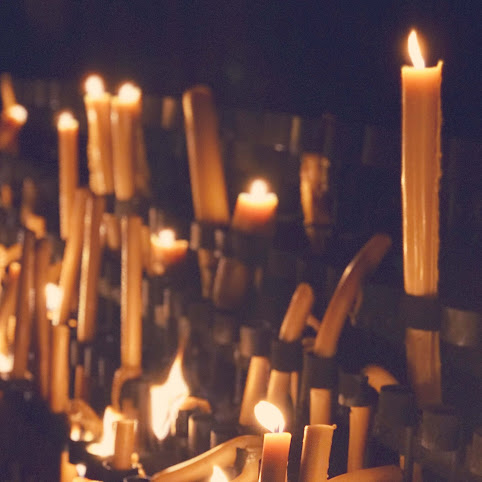
Candles at the Fatima Shrine in Portugal.

“What do you see when you're in the dark, and the demons come?” Mitch Leary (John Malcovich) asks Frank Horrigan (Clint Eastwood) in a creepy late night phone call in the 1993 movie In the Line of Fire. Eastwood, a secret service agent, failed to take a bullet for President Kennedy on that fatal day in Dallas, and the assassination haunts him to the present day. “Do you really have the guts to take a bullet, Frank?” Malcovich further taunts him in the brilliant, gripping screenplay by Jeff Macguire.

And what do you, reader, see when you're in the dark and the demons come? 

We all have a personal legion of demons who come to agitate and rattle us about ways we've messed up, people we hurt, things we should or should not have done--and who remind us that the windows of opportunity to repair the damage closed long ago. Living with them is a heavy burden. It destroys our peace.

Jesus wants to exercise these demons from us, give us his peace, and restore us so we can live in the fullness of life. 1  And he has the unique capacity to do so. 

One principle means to achieve this restoration is with the sacrament of Reconciliation. 

A central problem for many, though, is that confession is SCARY!!! Who really wants to go into a tiny room and tell a priest her or his deepest and darkest? 

And if confessing sins from the last few months isn't hard enough, the notion of making a general confession, where you confess the sins of your entire lifetime, is downright terrifying. 

If this echoes some of your sentiments regarding confession, you certainly aren't alone. Many, many forgo receiving the sacrament of Penance due to its awkwardness, or else they just don't see the point of it. 

The reality, however, is that making a confession is healthy and natural. As a sacrament, it's one of the “masterworks of God.” 2 And you needn't squirm over feigned awkwardness: the priest has heard it all before. 

Let's look more closely at the benefits of regular confession and why a general confession especially makes sense at this moment in time—then go over some practical ways to prepare for one. 

A Routine Cleansing 

Over lunch last summer, my friend told me that he only makes a confession once in a while, when he's done something particularly injurious that he's truly sorry about. 

This is pretty much on base with what the Church professes: 

“After having attained the age of discretion each of the faithful is bound by an obligation faithfully to confess serious sins at least once a year.” 3 

For my own part, I had an experience that convinced me I need to make confession a regular part of my life, regardless of whether or not I think I've done something “really bad.” 

Several years ago, I'd really had it with the priests and parish communities where I lived and decided to take a long break from confession. One night, I had a dream that I was in a filthy bathroom. A layer of dirt covered every surface area. It gave me the creeps just to be standing in the midst of it; like one of those gas station bathrooms that hasn't been cleaned for months and months. Then, a friend found me and guided me downstairs into a perfectly clean, sparkling and fresh bathroom. 

The next morning, a friend called and said that she was going to confession that afternoon and wondered if I wanted to join her? 

I was so surprised at this phone call; we never had “confession dates” before, lol; and I definitely made a connection between my dream and her invitation.

In the dream the bathroom represented my soul. Everyday sins dirtied it, so much so that even over a short span of time, it became unbearably filthy. Keeping my soul clean entailed a regular cleansing; i.e. confession. 

So after that, rain or shine, happy or sad with the priest or parish, and regardless of whether or not I thought I'd done anything exceptionally horrible, I made a practice of going to confession regularly. As a rule of thumb, I try to go about as often as I clean my bathroom. 😉

The Catechism on Confessions

Do you ever put something off for days and weeks, and over that time it just festers and gets worse? Take cleaning out your refrigerator. If it's not done regularly, all sorts of filth starts to grow onto leftovers and what not. Sometimes, nipping an ugly task in the bud is the easiest way to resolve it. 

The sacrament of Penance is a lot like that. In 1 John 1:9, John tells us, “If we acknowledge our sins, he is faithful and just and will forgive our sins and cleanse us from every wrongdoing. If we say, 'We have not sinned,' we make him a liar, and his word is not in us.” 

Looking at the ways we've failed is hard. However, a confession has a healthy psychological benefit: it's facing up to what we've done, which enables us to move past it. Here's how the Catechism phrases it: 

“The confession (or disclosure) of sins, even from a simply human point of view, frees us and facilitates our reconciliation with others. Through such an admission, man looks squarely at the sins he is guilty of, takes responsibility for them, and thereby opens himself again to God and to the communion of the Church in order to make a new future possible.” 4 

Essentially, confession allows for greater spiritual maturity. As the priest said in his homily at the Ash Wednesday Mass I attended: “If you go to confession regularly, you will experience spiritual growth. Guaranteed.” 

The Benefits of a General Confession

A general confession, which entails summarizing the sins of your entire lifetime, has been a tradition in the Church for some time now. St. Therese of Lisieux writes about making a general confession at her Carmel in France. 5  And the first section of St. Ignatius' Spiritual Exercises includes preparing for a general confession. 

But what is the sense in making one; of re-confessing sins you've already received absolution for in previous confessions? At first blush, it reminds me of a story a friend of mine told me of traveling to Lourdes with his family as a little boy. Although the intention of the trip was to seek healing for his ailing sister in the Lourdes water, upon arrival the volunteers at the grotto recommended he be dipped into the water as well. 

“But I'm already well,” he pointed out.

“But you will be better,” they insisted.

The notion of asking forgiveness for a sin more than once seems like a failure to trust or believe that Jesus wiped the slate clean the first time. 

--Add to it that it's just so dang hard to acknowledge an entire lifetime of sins in one sitting. 

Although a Catholic is under no obligation to make a general confession, there are in fact several good reasons for doing so—particularly at this point in time: 

  • In his Spiritual Exercises, St. Ignatius lays out some clear benefits of a general confession. For starters, he says it generates a greater contrition for all the sins of one's entire lifetime.
  • Another benefit he cites is that it increases our self-knowledge. We come to a greater understanding of our weak areas and tendency to sin, which allows us to heal. And it also shows us those areas where we've already healed and grown. 
  • And finally, he says that a general confession makes one better disposed to receive the Blessed Sacrament. And this in turn creates fortitude to no longer fall into sin. 6 
  • A final reason to make a general confession at this moment in time is to prepare ourselves for the Illumination of Conscience. As I've written several times before, the Illumination is unique in all of human history. It is a special moment in which God will reveal to every person his or her individual transgressions over an entire lifetime. Due to the Blessed Virgin's prophecies at Garabandal, there is good reason to think this Illumination will take place very soon; it's to happen, she says, when the world returns to the spirit of communism. Receiving this judgment will be a lot for any of us to palate, and making a general confession would mitigate the difficulty of this experience.

Appreciating these benefits of a general confession serves to ease the challenge of making one. And although not exactly being “men of the world,” most of the priests I've confessed to have been reasonable and easy enough to talk to. It's really expected of him, as the Catechism says: 

“The minister of the sacrament should....have a proven knowledge of Christian behavior, experience of human affairs, respect and sensibility toward the one who has fallen.” 7  

When I made a general confession, it was at a parish with an ENORMOUS line at the confessional. I honestly thought the priest would turn me away when he realized I was making a general confession, saying that he didn't have the time. But he didn't. And it was hard, but I stayed focused on what I was ACHIEVING from the confession: some sort of release and spiritual preparation for this upcoming decade. 

Now let's look at how one might prepare for a general confession—fortunately St. Ignatius has provided a coherent step-by-step guide.

St. Ignatius' Exercises to Prepare for a General Confession

As a young man in Spain around the turn of the 16th century, St. Ignatius of Loyola developed distinctive spiritual practices while praying alone in a cave for several months. After starting the Jesuit order around 15 years later, he codified these exercises, and novitiates complete them upon entering the order.

The term “spiritual exercises” encompasses a range of spiritual activities, including examination of conscience, meditation, contemplation, vocal and mental prayer. (Although the exercises, traditionally, are completed over a retreat lasting as long as thirty days, they can be adopted to any practitioner, over any time range that suits him or her.) 

Discernment is central to the exercises: identifying those desires and experiences in our lives that come from God, those that are from the devil, and those that originate from ourselves. This enables one to navigate a path toward God and the fullness of life Jesus promised us. 

The beginning of his exercises is dedicated to the contemplation of sin and preparation for a general confession. 

  • The Five Preparatory Exercises

In preparation for making a general confession, St. Ignatius suggests removing yourself from your daily life as much as possible. This way, to use his words, “The mind is not engaged in many things, but can give its whole attention to one single interest, that is, to the service of its Creator and its spiritual progress.” 8 

He lays out five separate exercises, 9 which I've simplified and summarized below. He recommends performing these exercises over the course of one day: the first exercise at midnight, the second upon rising, the third before or after Mass (before lunch), the Fourth at Vespers (early evening), and the Fifth an hour before supper. 

Since these were written in first person, I'm summarizing them here in first person as well. 

The First Exercise

I begin with a prayer asking God that this exercise might be oriented toward him. 

Next I complete two preludes:

First I meditate on “sin.” A visual Ignatius offers is a knight coming before a king and court after he's done something shamefully wrong, and after the king has given him many favors. (This visual gets at the kind of person Ignatius was.)

Second, I ask for the grace to be ashamed of occasions of sin. 

The body of this exercise entails meditating on the single sin of the angels that caused them to be cast into hell and the single sin of Adam and Eve that brought about the fallen state of the entire human race. 

Then I consider those who've led far better lives that I, who've sinned far less, yet who have incurred punishment and damnation.

Finally, I close with a Colloquy (which is basically a natural conversation with Jesus): After meditating on Him on the Cross, I answer these questions:

“What have I done for Christ?”

“What am I doing for Christ?”

“What ought I to do for Christ?”

The Second Exercise

The second exercise begins with the same preparatory prayer. 

This is followed by a prelude, this time asking for the grace of intense sorrow for sin. 

Next I record my sins, going over my life year by year, focusing on where I lived, my dealings with others and the positions I held. I look at my sins altogether, and then I look at myself compared to the almighty God. I look with awe on all of creation for having permitted me to commit these sins: the angels “through they are the sword of God's justice,” other humans, the saints, all of nature. 

Finally, I end with a Colloquy, speaking to God and thanking him for his mercy. 

The Third Exercise

The third exercise begins with the preparatory prayer. 

Next, I repeat the first and second exercises, focusing on which aspects bring consolation, and which desolation. 

I finish with three colloquies, speaking first to the Blessed Virgin, asking for her to help with self- knowledge and re-ordering my life, and to distance my life from worldly dangers. Then I make the same requests of Jesus and God the Father. 

The Fourth Exercise

The fourth exercise repeats the third, like a cow chewing on its cud, and closes with the same colloquies. 

The Fifth Exercise

The fifth exercise begins with the preparatory prayer.

Next, I meditate on hell, using all the five senses: seeing, hearing, smelling, tasting, and feeling the flames. 

One helpful description here is from St. Teresa of Avila's Book of her Life, a spiritual memoir she wrote around the age of 50. 

While I was in prayer one day, I suddenly found that, without knowing how, I had seemingly been put in hell….the entrance it seems to me was similar to a very long and narrow alleyway, like an oven, low and dark and confined; the flow seemed to me to consist of dirty, muddy water emitting a foul stench and swarming with putrid vermin. At the end of the alleyway a hole that looked like a small cupboard was hollowed out in the wall; there I found I was placed in a cramped condition.

All this was delightful to see in comparison with what I felt there….What I felt, it seems to me, cannot even begin to be exaggerated, nor can it be understood. I experienced a fire in the soul that I don’t know how I could describe. The bodily pains were so unbearable that though I had suffered excruciating ones in this life and according to what doctors say, the worst that can be suffered on earth…these were all nothing in comparison with the ones I experienced there. I saw furthermore that they would go on without end and without ever ceasing.

This, however was nothing next to the soul’s agonizing: constriction, a suffocation, an affliction so keenly felt and with such a despairing and tormenting unhappiness that I don’t know how to word it strongly enough. To say the experience is as though the soul were continually being wrested from the body would be insufficient, for it would make you think somebody else is taking away the life, whereas here it is the soul itself tears itself in pieces.…..I felt myself burning and crumbling; and I repeat the worst was that interior fire and despair….

the Lord wanted me to actually feel those spiritual torments and afflictions, as though the body were suffering. 10

(St. Ignatius of course doesn't include this excerpt in his exercises, but I have found it's a pretty thorough description, and so helpful for a meditation.)

Next, I ask for a sense of pain that the lost suffer, and for a fear of hell, an appreciation of its reality as a motivation to live an upright life.

I close with a colloquy, talking with Jesus about those who are condemned, and thanking Him that he's been merciful to me. 

And that wraps up the five exercises: after completing these, anyone is pretty well prepared to make a general confession. Most priests are available to hear confessions at least once a week. 

St. Ignatius makes a few comments on penance. 11 He suggests giving up food, sleep, and practicing forms of asceticism that make you uncomfortable but that don't hurt you physically (like taking cold showers, for example). He says that identifying suitable penance is a discernment process, and recommends talking over with God what is best for you. 

A Lesson From the Three Little Pigs

My two-year-old nephew has an indefatigable obsession with the story of the three little pigs, and last summer I read it to him over and over again. And yes, at the risk of being unbearably banal, I am going to go here: I found that it offered a powerful spiritual lesson. 

Although from one vantage a general confession seems intimidating, from another it's a wise thing to do. We all choose the foundations that we build our lives upon. Prudently laying a foundation of bricks fortifies us for the spiritual battles we face in this dark hour. 

Jesus assures us that his yoke is easy and his burden is light, and when we've cast all our cares upon him, and asked for His forgiveness, our reward is a light and carefree conscience.

But enough from me. What's your take on confession? Do you receive the sacrament regularly and believe it's beneficial? 

🍃


1 cf John 14:27, John 10:10.

2 Catechism of the Catholic Church. Doubleday Publishers, April 1995: Paragraph 1116 

3 Catechism of the Catholic Church. Doubleday Publishers, April 1995: Paragraph 1457.

4 Catechism of the Catholic Church. Doubleday Publishers, April 1995: Paragraph 1455.

5 Story of a Soul: the Autobiography of St. Therese of Lisieux. Translated by John Clark O.C.D. ICS Publications, 1996: page 149.↩

6 The Spiritual Exercises of St. Ignatius. Translated by Louis J. Puhl, S. J. Loyola Press, 1951: Page 24.

7 Catechism of the Catholic Church. Doubleday Publishers, April 1995: Paragraph 1466.

8 The Spiritual Exercises of St. Ignatius. Translated by Louis J. Puhl, S. J. Loyola Press, 1951: Page 10.

9 The Spiritual Exercises of St. Ignatius. Translated by Louis J. Puhl, S. J. Loyola Press, 1951: Pages 25-33.

10 Volume 1: The Collected Works of St. Teresa of Avila. Translated by Kieran Kavanaugh, OCD & Otilio Rodriguez, OCD. ICS Publications, 1976: Page 214.

11 The Spiritual Exercises of St. Ignatius. Translated by Louis J. Puhl, S. J. Loyola Press, 1951: Pages 38-9.

Share:

12/19/21

The Lottery Has Come to Small Town America

'It isn’t fair, it isn’t right,' Mrs. Hutchinson screamed, and then they were upon her. 

~ The Lottery, Shirley Jackson

Advent is being in a dark cell. Then the door opens from the outside, and light comes in. 

~ Father Robert McTeigue 

All the goings-on in my life have given me fodder to reflect on the state of things this Advent. 

My sister came into town two weeks ago, and as women do, particularly at this time of year, we shopped. She tried on pajamas at a spendy boutique. I tried on sweaters, and flummoxed over whether or not to make a purchase. 

We attended a local fair, where artists displayed artwork and handcrafts at booths set up inside community halls, a masonic lodge, and one giant yurt. Artisans sold slippers made from recycled clothing, wall hangings of fruit and flowers created from washi tape, nuno felted capes and dresses, and birdbath tile mosaics. 

In a photographer's booth, surrounded by enormous images of red and orange poppies that felt very Georgia O'Keeffe-esque, I ran into an old friend. We've known each other for years but I haven't seen her in a while. Maybe even a decade. 

She had on a zip-up fleece with a logo of the new Seattle Kraken, which I mistook for the Seahawks. Oh, no, she laughed. She'd given up on the Seahawks for the season. Mostly, anyway. She still had her fingers crossed for their game against the 49ers that weekend. It was the big rivalry with her California-based family. 

I asked her how she'd been, and things got a little more dour. 

“It's been a rough couple of months,” she told me. “My dad died, and my dog died. He was ten years old. My other dog is on his last legs.” 

“Gee--that's rough!” I scrambled as to where to take the conversation from there, and stammered for a bit before settling on a course. 

“When did your dad die?”

“Oh, this was a few months ago. It was one of those cases of someone who didn't react well to the vaccine. He was in the hospital right away. He was near family when he passed.....” her voice trailed off. 

I told her how sorry I was, she said I needed to come see her since I was in town. And she moved on to another booth, as I continued looking at images of fields of poppies, reproduced onto mousepads, mugs, greeting cards and posters. 


But her conversation stayed with me. It felt so natural: we hit the regular beats, said all the right things. She told me about the death of her father with the cadence of everyday small talk--a death caused by a vaccine imposed by de facto mandate; a vaccine the government assures us is perfectly safe. 

According to the statistics on VAERS, these sorts of conversations are taking place at craft fairs, school Christmas concerts, and holiday gatherings all across the country. 

To date, the reports of adverse events for the covid vaccine include 20,244 deaths, 33,676 permanent disabilities, 10,229 heart attacks, 19,039 incidents of myocarditis, and 106,129 hospitalizations. According to Steve Kirsch's research based on anaphylaxis incidents, these numbers are underreported by a factor of 41. 

The evidence is clear. This Advent, interwoven with listening to Handel's Messiah, exchanging tins full of molasses cookies, shortbread, and Russian tea cakes, and shopping for the perfect Christmas tree, people are caring for a son, now permanently injured from the vaccine, a husband who's weakened from a heart attack, and mourning a parent's sudden passing.

The atmosphere of Christmas is usually reflected in joyously silly movies like White Christmas, and heartwarming movies like It's a Wonderful Life, which remind us that actions have far-reaching consequences, and that the individual matters. 

There's still the typical parties, with steak, cheese charcuterie boards and spiked eggnog. And once again, we're listening to the fire truck blare Christmas carols through the neighborhood, while sitting at home, stringing popcorn for the Christmas tree and sipping cider mulled in cinnamon and cloves. 

But there's a different spice in the air this year. It's not the comforting blend offered in a story like Truman Capote's “A Christmas Memory”, in which he relates a childhood memory of flying kites on Christmas morning with a dear aunt.

It's much sharper. There's an unsettling harshness to it. It's more akin to the horror in Shirley Jackson's short story “The Lottery," in which a small town of 300 or so gathers for its annual ritual of picking numbers from a black box. 

Next, the mob descends up on one unlucky individual to stone her to death. 

The real shock of the story is the ordinary way in which the monstrous ritual is conducted. Just before the lottery, the men discuss crops and weather, and the women exchange gossip. The lottery is run by the same man who organizes the square dance, the teen club and the Halloween program. 

Stoning someone to death is just part of life in this small town in America.

In our blasé acceptance of the suffering brought about by this vaccine, we've embodied Jackson's characters without missing a beat. 

“It's just the way things are now,” we're collectively saying. “Decent people get vaccinated, and some of us will die or be seriously injured from it.” 

🍃

Earlier that same weekend I attended a funeral Mass and burial for an infant who died when the mother went into labor 22 weeks into her pregnancy.

The would-be first time parents couldn't come close to communicating the devastation and horror of it all, but they told about her water breaking in the middle of the night, the mother spending a week in the hospital hoping and praying she wouldn't go into labor, her contractions a week later, and the two of them watching as their little girl's heart stopped beating during her first few moments in the world. 

They held her in the palm of their hands, lovingly touching her tiny fingernails and little feet. 

Just two weeks earlier my friend had been telling me about the books she was selecting for their baby shower registry. 

And now she's crying like she can't stop. And then crying some more. Sobbing, convulsing, late into the night. 

Both parents are vaccinated. The mother speaks of the unvaccinated in the same way she'd talk about poor uneducated trailer trash. And so any correlation between the vaccine and this infant demise would sound to them like a non-sequitur. 

Yet, not a few expecting mothers have reported spontaneous abortions following their covid vaccine. The current VAERS number is 3,297.  As I mentioned earlier, these numbers are underreported by a factor of as much as 41, so a more accurate estimate is closer to 135,000.

We'll never know if the vaccine caused this particular infant demise. No one has looked into it, nor will they. But, given the VAERS statistics, it's just as accurate to say there's no way anyone could claim the vaccine couldn't have played a part. 

The accurate statement, then, is that the vaccine may very well have caused this mother's water to break at 22 weeks, and the delivery of a baby several weeks premature, who died within minutes.

The priest led us in prayers at the cemetery, talking about the angels who would come to welcome her, and ending with “eternal rest grant unto her and may perpetual light shine upon her.” 

Later, he told us that two other young couples from the parish had reported miscarriages that same week. 

A few months earlier, this priest, standing before the altar following Mass, pleaded to all of us to take the vaccine. He was praying that we would. 

Whoever Has Ears Ought to Hear

My sister and I attended Sunday Mass on her visit. After the priest made the final blessing and we all started to exit, she looked startled. 

“What?” she turned to me. “No St. Michael the Archangel prayer? Every Church I've been to these past three years says it. I was expecting it. This is the first church I've been to who hasn't said it.” 

I, too, had noticed this phenomenon springing up, of parishioners kneeling and praying the St. Michael the Archangel prayer following the final blessing. During the riots in Portland in 2020, The Archbishop of Portland even instructed parishes in his Archdiocese to pray it following Mass. 

The Prayer to St. Michael used to be prayed at the end of the Tridentine Liturgy, and I believe it fell out of practice with the rollout of Novus Ordo in 1969, following Vatican II.

In 1884, Pope Leo XIII wrote the prayer after receiving a vision while standing before the altar following Mass. As the story goes, he fell into a trance and saw Lucifer conversing with Jesus:

“I can destroy your Church, I only need time and power.” Jesus granted him both. 

The Pope also saw St. Michael the Archangel casting Lucifer and his legions into hell. 

Here is the prayer we now say, much abbreviated from the original version: 

St. Michael the Archangel,
defend us in battle.
Be our defense against the wickedness and snares of the devil.
May God rebuke him, we humbly pray,
and do thou,
O Prince of the heavenly hosts,
by the power of God,
thrust into hell Satan,
and all the evil spirits,
who prowl about the world
seeking the ruin of souls. Amen.

(It's curious that this passage, from Pope Leo XIII's original transcription, has been removed: 

These most crafty enemies have filled and inebriated with gall and bitterness the Church, the spouse of the immaculate Lamb, and have laid impious hands on her most sacred possessions. In the Holy Place itself, where has been set up the See of the most holy Peter and the Chair of Truth for the light of the world, they have raised the throne of their abominable impiety, with the iniquitous design that when the Pastor has been struck, the sheep may be scattered.)

🍃

Recently, I read the first chapters of the Book of Revelation and was struck by the repeated refrain “Whoever has ears ought to hear what the spirit says to the churches.” It's repeated seven times between chapters 2 and 4. The author is speaking to the church of Ephesus, and the six surrounding Churches, many (possibly all) of which Paul established in his second and third missionary journeys. 

I am at a point where my eyes cannot roll further back, my disdain could not grow any deeper, my revulsion could not be any stronger at the idiocy and inhumanity I witness over and over and over again at the hands of priests. 

Watching a priest propagate the infanticide of children in his parish after celebrating Mass feels like too much to bear. 

But I do find it curious to see this prayer creeping back in. It's reassuring. It's as though to say: on a surface level, the Church is clueless. But the Spirit appreciates what we're up against. And has poised the Church for battle.

Wonderful Counselor?

The Advent season of 2021 has been a mind-fuck indeed. (I mean, look at these numbers of injuries from VAER's red-box summaries. Do you see any problem with claiming that the vaccine is safe?)

Watching people passively, and more often aggressively, jump on the vaccine train reminds me of that scene from Trains, Planes and Automobiles, where Steve Martin and John Candy get criss-crossed and start driving on the wrong side of the highway. 

When well-intentioned drivers scream out to them “You're going the wrong way!!!”, the pair puts their thumbs to their nose and wiggle their fingers. 

“How do they know where we're going?” they hoot.

Then they see two semi-trucks driving straight at them at 70 MPH. 

🍃

A few months ago, I prayed, and told Jesus he felt like the sort of friend who's great to have around, but that I couldn't see much more to him that that. 

Any notions reflected in Isaiah 9:6, all of that about being a "Prince of Peace" and a "Wonderful Counselor" I just didn't see. 

A few nights later I was awoken to the moon, peeking behind a shroud of clouds.

It was beautiful.

And I heard Jesus asking me, rhetorically: “So you don't think that I am powerful?”

🍃

I don't have a lot of hope for the world situation. It's horrific to watch people stubbornly, self-righteously dig their own graves, and so many more casually accept mass suffering. 

The hypnosis is so resolute that an epiphany feels like a big ask. Not a few vaccine advocates spit upon anyone who suggests they're driving in the wrong direction. 

But perhaps my despair is a matter of perception. 

As a Catholic, I know we've inherited a fallen state; the sin of Adam became the sin of us all. But I also know we're better off because of it: “Oh happy fault, or glorious sin of Adam which gained for us so great a redeemer.” 

During her dark nights, The Little Flower resorted to making acts of faith. As she recounts in her autobiography: 

The fog that surrounds me becomes more dense; it penetrates my soul and smothered it so that I could not picture the sweet image of my Fatherland. When I try to find peace...my torment redoubles. The voice of unbelievers come to mock me, saying 'You are dreaming about the light, about a Fatherland embalmed in the sweetest perfumes; you are dreaming about the eternal possession of the Creator of all these marvels; you believe that one day you will walk out of this fog that surrounds you. Hope on! Hope on! And look forward to death. But it will not give you what you hope for, but a more profound night, the night of annihilation.' 

Although I had not the consolation of faith, I forced myself to act as if I had. I have made more acts of faith in the last year than in the whole of my life...I tell Jesus I am ready to shed blood to the last drop to profess my faith in the existence of heaven. 1

No doubt about it, an especially dark night is descending up on us this Advent. It's unlikely we'll experience any consolations in the immediate future that we've been gifted with an Almighty God, a Prince of Peace who will reign forever and ever. 

This year, more than ever, trusting in this reality requires act of will. Just like the Little Flower, it requires making acts of faith...possibly more than we've made in the whole of our lives. 

1 St. Therese of Lisieux, Story of a Soul. Chapter X.↩

Share:

10/15/21

Simplicity & Beyond: Finding God in Present Moment

Fear lives in the psychological space where God is absent. Every second is a creation, an act of re-creation. God is recreating us and giving us the opportunity to be who He wills us to be. If you walk around with that thinking, you are never alone, and there is no space where fear can set in.   -Doctor Vladamir Zelenko

There is no fear in love, but perfect love casts out all fear. 1: John 4:18

Have you noticed how your outlook completely changes over the course of a week or two?

I had a friend call me out of the blue a few weeks ago and we talked for over two hours. Her call felt like someone reaching out and taking my hand in the midst of a dense, impenetrable fog.

I had been in my room crying the night before; the sense of nowhereness this pandemic had thrown my life was at an all-time high. Plus, I was feeling the consequences for not playing along and getting vaccinated. The hatred came from all directions; friends and family members, the state, and the media.

And then, a few weeks later, she called again. And I was amazed at how much my mind-set had shifted in that short space of time. My life had energy and clarity and momentum that had been completely absent three weeks earlier.

Without paying attention to the details of our lives, it's hard to account for these shifts.

Recognizing God in the Present Moment

According to Zelenko, in order to meet God, all we have to do is Be. Here. Now. Remaining in this recognition comes with a great incentive: we live without fear! (Do you walk around acknowledging that you're never alone?)

If God is right here, he probably isn't keeping entirely silent.

How do we recognize this voice? And what, if anything, does He ask?

It's So Simple 

Many Doctors of the Church profess the simplicity of God.  

You are simplicity itself.   -St. Augustine 1

The nearer one gets to God, the simpler one becomes.   -St. Therese of Lisieux 2

God is no wise composite, but is altogether simple. Every composite is posterior to its component parts, and is dependent on them; but God is the first being. Every composite has a cause, for things in themselves different cannot unite unless something causes them to unite. But God is uncaused.   -St. Thomas Aquinas 3

Simplicity, it appears, is a fundamental characteristic of this God who meets us here in the present moment.

This certainly provides clues on where not to look for God: in the complicated, the overwhelming, the confusing. Not in rambling words or complex thoughts.

How would a simple being communicate?

In all likelihood, with clarity. Startling, almost abrupt clarity. With direct words and phrases that get at the heart of the matter; Jesus often spoke like this.

And so identifying the simple in our day is one way to recognize God in them.

(As I've written about in a previous post, I think the simplicity of the Illumination of Conscience is one of the central reasons we can conclude it comes from God.)

It's Personal 

From my own experience and speaking to others, and from scripture, it's clear this communication is very intimate. Psalm 139 tells us:

Lord, you have probed me, you know me: you know when I sit and stand; you understand my thoughts from afar. My travels and my rest you mark; with all my ways you are familiar. Even before a word is on my tongue, Lord, you know it all.

People are drawn to different spiritualities (Ignatian, Carmelite, Franciscan, Benediction) and devotionals based on their personalities, preferences, and cultural heritage. Some take great stock in dreams, or journaling as a way to pray. For others, it's far more intellectual.

That is to say, a prerequisite to hearing God speaking in the present moment is, as the Delphic maxim says, to know thyself. 

Also, we can anticipate communication from God will be very, very intimate: closer than a good friend.

It Brings Quiet 

It's very hard to distinguish between thoughts or messages that come from ourselves and those that come from God. St. Teresa of Avila wrote about this at length, with respect to discerning locutions. However, I think her criteria applies across the board:

The words the Lord speaks.......touch the soul, giving it light, favor and bring it quiet. 4

A fruit of God's presence is peace. And so looking for God in our day means identifying those people, situations, and encounters that bring about peace.

(Note: St. Teresa is VERY wordy, and so I truncated this quote without, I’d say, altering its meaning. The entire quote is in the footnotes.)

He'll Ask a LOT 

So God speaks to us simply and personally---and a fruit of this voice is peace.

But what of the substance of what he says? What does he ask?

Although scripture provides many answers to this question, Jesus provides one that applies across the board:

Whoever wishes to come after me must deny himself, take up his cross, and follow me.   -Matthew 16:24

“Must” indicates a fundamental requirement; the cross is part and parcel to being in relationship with Jesus. And so accepting the cross is a way to encounter God in the present moment.

Identifying one's cross (which difficulties to accept, which to avoid) is a discernment process. But any Christian can rest assured they'll be presented with one (or two).

Amidst the Cacophony

Oh, it's so basic, listening to your own life: noticing patterns, identifying relationships and how they affect us, noticing a shift towards or away from certain people and affiliations. Our dreams, sleep patterns, money spent, food eaten. All the incidents and circumstances in which God meets us.

Yet, with so much going on just in one single day, it's hard to filter through all the goings-on to identify the correlation, say, between a shift in mood and a program we listened to, or eating patterns and a stressful relationship.

That is to say, recognizing where God is and where he is absent necessitates a deliberate practice.

St. Ignatius's Spiritual Exercises merit a call-out here, although I don't profess to proficiently understand nor practice them. His examen, (done at the end of each day) is a practice of identifying moments of desolation and consolation; i.e. where God was either present or absent in circumstances, events, relationships.

One thing I never got about the examen is this idea that desolation is supposed to be a sign of God's absence. However, accepting a cross oftentimes yields despair and discouragement.

Anyhoo, for me, simply transcribing what occurred during a week, or over the course of a month, brings me to a more conscious awareness of all aspects of my life. Rather than simply shuffling through the events of the day, it forces me to pause and look at them.

Who has come into my life? What activities have I been drawn to? What, if anything, might God have been telling me in a dream, or through a series of coincidences?

It's VERY interesting to read back through these entries. I certainly notice developments over the course of several weeks or months. And the hand of God at work in ways that weren’t clear in the moment.

For example, during a year when I traveled the world, on three separate occasions I coincidentally ended up in a city where a friend or family member was visiting at the same time. This happened in Dublin, Porto, and London. It struck me as an uncanny coincidence in retrospect, and I interpret it as God providing me with companionship in a place where I'd otherwise have been on my own.

With respect to the episode I related at the beginning of this article: when I looked through everything that transpired during the three weeks in which my mood shifted so dramatically, I identified several things to attribute it to. One was registering to attend the Porcfest in June of 2022. Having a future plan, with people who are (hopefully) sympathetic to my POV, put a completely different framing around my circumstances.

Well, if you've followed my somewhat meandering thought process up to this point, then here you are.

What about you? Do you have any practices that you use to listen to God in your everyday?


1 The Confessions. St. Augustine, Chapter 4↩ 

2Story of a Soul. St. Therese of Lisieux, Chapter 8

3 Summa Theologica Part I, Thomas Aquinas. 1213. Question 3

4 Volume 1: The Collected Works of St. Teresa of Avila, translated by Kieran Kavanaugh, OCD & Otilio Rodriguex, OCD, 1976. Pg 163. “Another sign more noticeable than all the others is that these words composed by the intellect do not produce any effect. Those the Lord speaks are both words and works. And even though the words may not be devotional ones but words of reproof, they dispose the soul and prepare it from the very beginning, and they touch it, giving it light, favor and bring it quiet. And if the soul suffers dryness, agitation and worry, these are taken away as though by a stroke of the hand since it seems the Lord wants it to understand that He is powerful and that His words are works.”

Share: